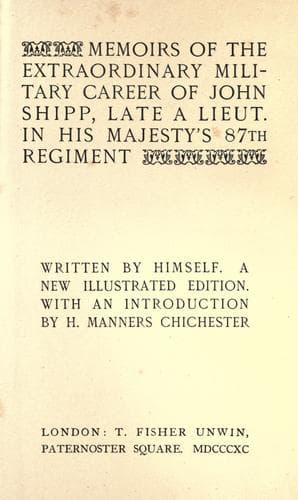
Memoirs of the Extraordinary Military Career of John Shipp: Late a Lieut. in His Majesty's 87th RegimentShipp, John
History
Memoirs of the Extraordinary Military Career of John Shipp: Late a Lieut. in His Majesty's 87th Regiment
Shipp, John
India -- History -- British occupation, 1765-1947 -- Biography; Shipp, John, 1784-1834
In all nations, even in Europe, the practice of punishing spies is
recognized as just; but their execution is generally public, and not
without the sanction and approbation of the governor or
commander-in-chief; and no piquet, post, or guard, dare inflict the
penalty of death. This poor creature was seized, and literally cut to
pieces; and it was supposed, by the medical people, that he must have
died a death of extreme agony, for the ground under him was dug up with
his struggling under the torture which had been inflicted on him. His
arms had been cut off, about half way up from the elbow to the
shoulder; after which it appeared that two deep incisions had been cut
in his body, just above the hips, into which the two arms had been
thrust. His features were distorted in a most frightful manner. Our poor
fellows wept bitterly over the sight, and swore, in the bitterness of
their anger, that they would revenge this foul and bloody deed; and I
had great difficulty, with their gallant captain, in restraining them
from following those savages into the wood. The pioneers having arrived,
the poor wretch was committed to his last home, amidst the sympathy of
all around.
Ettoondah was the name of the place where this barbarous murder had been
committed; and a more lovely or more picturesque spot there is not in
the created world.
Here we had some tolerably good fishing, by tying our horse-blankets
together, and then dragging the stream. We remained here some days, for
the purpose of making this our grand depot; for which purpose, in the
lower house, which was better situated than the other, and not so near
the wood, we built a large and strong stockade, with six embrasures for
guns. This house we converted into store-rooms, and here we left all our
superfluous baggage. I had no superfluities; one thing on and one off
was quite enough for any man on such a service, and I often regretted,
with many of my brother officers, that we had not brought packs, like
the men, which would have carried our all safely, and entirely relieved
us from the apprehension which we now felt of losing those things not
immediately in our presence.
The domestic fowls, kept by the natives, had strayed into the adjoining
woods, and there bred, and had become very numerous. At night they
roosted on the trees, without any apparent fear of molestation. Firing
was most strictly prohibited within a mile of camp; and justly so, or we
should, if permitted, have had the soldiers firing away their
ammunition, and the camp alarmed. Many of the fowls, however, were
caught and eaten.
[Illustration]
CHAPTER XIII.
Public-domain text, read in full here on John Shaqi.
Reviews
Reviews
No reviews yet
Be the first to share your thoughts on this work.
Elsewhere in the archive
Join the Discussion
Join the discussion
Sign in to leave a comment or review.
Sign InorCreate an account