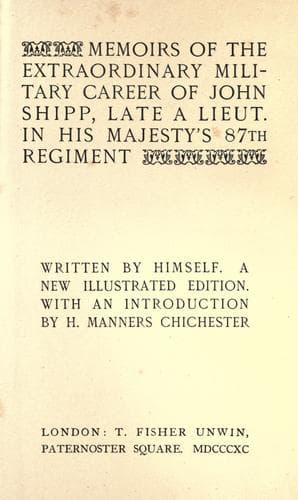
Memoirs of the Extraordinary Military Career of John Shipp: Late a Lieut. in His Majesty's 87th RegimentShipp, John
History
Memoirs of the Extraordinary Military Career of John Shipp: Late a Lieut. in His Majesty's 87th Regiment
Shipp, John
India -- History -- British occupation, 1765-1947 -- Biography; Shipp, John, 1784-1834
quite out of patience with his folly. I did not like to quit my man; so
I tried his other extremities; but he would not stand still, all I could
do. At length, I made a feint at his toes, to cut them; down went his
shield from his face, to save his legs; up went the edge of my sword
smack under his chin; in endeavouring to get away from which, he threw
his head back, which nearly tumbled off, and down he fell; and I assure
you, reader, I was not sorry for it, for he was a most unsociable
neighbour. I don't know whether I had a right or not, but I took the
liberty of taking his sword, gold crescent, turban-chain, and large
shield. The latter I sported on my left arm during the action, and it
was fortunate for me that I did, for I found that the shield was
ball-proof, and I should have been severely wounded, had I been deprived
of this trophy. Our gallant captain fought like one of the old Fogs, and
his men, as I had been told, were indeed "divels to fight." The very
noise they made would have frightened old Harry himself.
The enemy fought furiously before they gave up the hill; indeed, many
of them rushed upon our bayonets in the most reckless and desperate
manner. Being at last compelled to give way, they took up their station
on the adjoining hills, and in the ravines and valleys below, and their
fire for a time was destructive. As we had now gained the hill, we had
proceeded to the extent of our orders. Here reinforcements poured up to
our assistance, and two six-pounders, which had been sent up immediately
after us, now began to play with grape on the poor and brave fellows who
had sought refuge in the dells below. The havoc was dreadful, for they
still scorned to fly. During our ascent, some shells had been thrown by
our artillery below, from some howitzers in front of our encampment, to
the right of the ridge of the hill, where the enemy, in immense force,
had been observed running down to the assistance of their beaten
comrades. This reinforcement of the enemy brought down, to play upon our
ascent, a small hill-gun, a three-pounder of about a yard long, which
one man could carry. The whole of the ammunition brought by the enemy
for this and other purposes, our shells from below reached and blew up,
and great numbers were killed and wounded by the explosion. When their
ammunition was gone, they rolled the little gun down the hill, where we,
after the action, found it. Our troops having been distributed and
posted along the range of hills, some of our men were killed and wounded
by each other, by their cross-firing at random, where they heard the
sound of muskets, but could not see the object. We frequently sounded
"cease firing," but to no purpose; and, indeed, it was truly tantalizing
to see thousands of the enemy under our very noses, and not to be
allowed to fire at them; but, the woods being thick and high, we were
fearful of again drawing on ourselves the fire of our men on the
opposite hills.
Public-domain text, read in full here on John Shaqi.
Reviews
Reviews
No reviews yet
Be the first to share your thoughts on this work.
Elsewhere in the archive
Join the Discussion
Join the discussion
Sign in to leave a comment or review.
Sign InorCreate an account