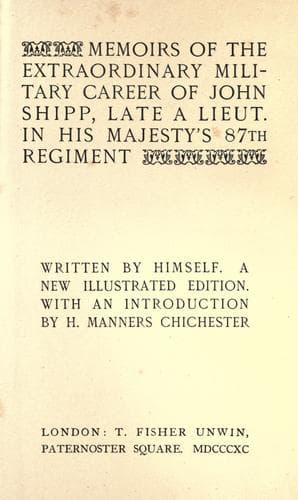
Memoirs of the Extraordinary Military Career of John Shipp: Late a Lieut. in His Majesty's 87th RegimentShipp, John
History
Memoirs of the Extraordinary Military Career of John Shipp: Late a Lieut. in His Majesty's 87th Regiment
Shipp, John
India -- History -- British occupation, 1765-1947 -- Biography; Shipp, John, 1784-1834
As all treaties contracted in India, between native and European powers,
are ever to be held with a jealous and watchful eye (for naught but time
can make them valid), it was necessary for us to take up a position to
watch the proceedings of our new friends. Under the cloak of friendship,
some of the most barbarous massacres have been perpetrated; and treaties
have been frequently signed and sealed, and, ere the signature was dry,
the enemy have commenced infringing on their contracts and sacred ties.
It has even been known that, during the time occupied by the parley
necessary for completing such negotiations, the enemy have been busily
engaged in making preparations for striking a more effectual blow. It
was but prudent, therefore, that we should keep our eye upon them. In
accordance with one of the covenants of the treaty, a British resident,
and the usual escort, were to remain at the capital. This escort
marched, on the same day we did, to Khatmandoo. Our march was through
the pass of Cheriagotte, where the mad-brained young officers wanted to
force an entrance. My description of this pass, as I proceed, will prove
how fatal, and contrary to the dictates of reason, would have been any
such attempt.
I was on the rear-guard the morning we left the valley of Muckwanpore.
The enemy--or, perhaps, I should say our friends--flocked in great
numbers, to bid us farewell, or see us depart. The whole of the baggage
was nearly gone, when a number of these soldiers gathered round the
guard, asking all manner of questions. A most respectable-looking young
man, wearing the dress of an officer, came up to me and said, "Were you
not in the action on the hill of Muckwanpore?"
I told him that I had had that honour.
He replied, "So was I; and I fired three shots at you from behind a
tree--are you not wounded?"
I replied, "No."
"Well," said he, "I never missed my man before in my life."
I asked him at what period of the action it was that he aimed at me.
"When you were fighting with Sobah Khissna Rhannah," replied he.
"You were not far from your man, then," said I, "for one of your shots
struck the peak of my cap."
At this he laughed. He afterwards complimented me on my swordmanship,
and said that few could touch the sobah in that exercise. He then asked
to look at one of my men's muskets, and he put himself through the
manual and platoon exercises, giving himself the word of command in
English. I never saw motions more clean or more compactly executed. I
asked him where he learned English, and the English modes of drill. He
replied, "From Browne," who was a deserter from the Company's European
regiment. He added, that a man of the name of Bell, a deserter from the
Company's Foot Artillery, had also taught him his exercise, and Browne
had instructed him in English. The former, he said, had been made
colonel of artillery, and the latter schoolmaster; but they had both
been discharged from the service at the commencement of the war.
Public-domain text, read in full here on John Shaqi.
Reviews
Reviews
No reviews yet
Be the first to share your thoughts on this work.
Elsewhere in the archive
Join the Discussion
Join the discussion
Sign in to leave a comment or review.
Sign InorCreate an account