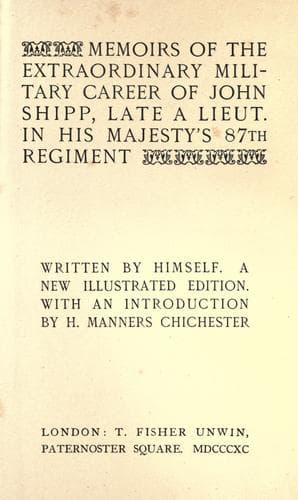
Memoirs of the Extraordinary Military Career of John Shipp: Late a Lieut. in His Majesty's 87th RegimentShipp, John
History
Memoirs of the Extraordinary Military Career of John Shipp: Late a Lieut. in His Majesty's 87th Regiment
Shipp, John
India -- History -- British occupation, 1765-1947 -- Biography; Shipp, John, 1784-1834
When we reached the other side, the eye was met by stockades, fortified
hills in all directions, and strong breastworks thrown across the
roadway, which was here somewhat wider; though our road all along was,
in fact, nothing more than the bed of a river, surrounded and commanded
by numberless little fortified sugar-loaf hills. These the foe had been
obliged to ascend by means of ladders. To complete the destruction these
hills must have dealt upon us, they had poisoned a stream of water,
either previous to our march from the ravine some ten days before, or
since the treaty of peace was signed; but this was timely detected. The
poisonous grass I have before alluded to, had been sunk in a kind of
basin, which was constantly replenished by water that fell from the
rocks behind it. This might be about twenty yards round, and two deep.
On the morning of our return, an elephant, belonging to
Lieutenant-Colonel Rose, of the Company's army, as also a horse
belonging to that officer, had preceded the army, and even the baggage.
The elephant got his fore feet in the water, of which he drank a little,
but seemed not to relish it. The horse could not be induced to drink
much, nor would the elephant again touch it. When urged by his keeper,
such was his perverseness, that the driver descended, and, on looking at
the water, he saw a yellowish colour rising to the surface, which was
caused by the pressure of the elephant's feet on the grass. The keeper
immediately introduced his hand, and pulled out the poisonous herb. This
occurrence was without delay communicated to our gallant commander; and,
never shall I forget his indignation and displeasure at this
intelligence. The fact being ascertained by the medical department, and
both the elephant and horse dying shortly afterwards, Sir David
peremptorily called upon the Nepaul government for satisfaction for this
diabolical attempt to poison his army; but they denied all knowledge of
such a base transaction, protesting that the heads of the offenders
should be the penalty, if they could discover the authors of such a
scheme, which they affected to suppose must be the act of some
individual who had sustained injury by the war. They promised that a
most strict inquiry should be set on foot, and that the result should be
made known to our government. Here, I believe, the business ended; at
least, we heard no more of it. A guard was, after this discovery,
placed on the poisoned water, to prevent any of the cattle that followed
from drinking it; and the basin was afterwards filled up by our
pioneers, as an effectual remedy to prevent any other travellers that
might be journeying that way from becoming its victims.
Public-domain text, read in full here on John Shaqi.
Reviews
Reviews
No reviews yet
Be the first to share your thoughts on this work.
Elsewhere in the archive
Join the Discussion
Join the discussion
Sign in to leave a comment or review.
Sign InorCreate an account