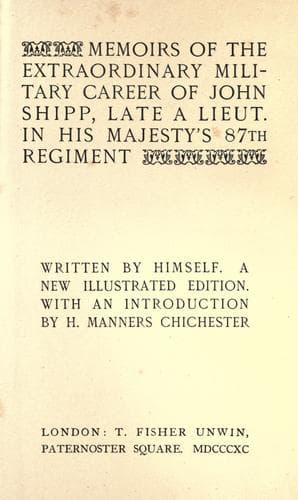
Memoirs of the Extraordinary Military Career of John Shipp: Late a Lieut. in His Majesty's 87th RegimentShipp, John
History
Memoirs of the Extraordinary Military Career of John Shipp: Late a Lieut. in His Majesty's 87th Regiment
Shipp, John
India -- History -- British occupation, 1765-1947 -- Biography; Shipp, John, 1784-1834
Had I known this good news before, I would have thrown all the life and
soul of a baggage-master into the character of Lord Duberley. As it was,
no intelligence could be more welcome to me. On the following morning I
wrote to the brigade-major to know if the information was true. He
replied by note that it was, and apologized for having, through
multiplicity of business, forgotten to mention to me that I must join
the left division of the grand army forthwith. They had left Cawnpore
two days before. Being now sure of this good news, I communicated it to
my wife, and fixed the following day for my departure. I then waited on
the noble marquis, to thank him for my preferment. His lordship received
me with great kindness. "Mr. Shipp," said he, "you have no occasion to
thank me, but your own merit, and the kindness of Major-General
Marshall, who requested the appointment of me as a favour conferred on
him." His lordship concluded, "I will not ask you to dine to-day, as you
would in all probability prefer spending the short time you have to
spare with your family." I expressed my grateful sense of his lordship's
kindness, and returned home and spent the day with her whom I loved best
on earth. In the evening I took leave of my brother officers, and on the
following morning, ere the cock crew, I had taken an early breakfast,
and by the time the sun left his slumbering couch I was some miles on my
road, to join the left division of the grand army.
There is a kind of pensiveness by which the human mind is assailed on
separating, though for a short time only, from pleasant acquaintances;
but, when we part from objects bound to us by the dearest ties of love
or consanguinity, an indescribable weight oppresses the heart. I felt
this in parting from the most affectionate of women, to enter on a new
series of wars, perhaps never to behold her again. These thoughts will
intrude, in spite of all one's efforts to repress them, where the heart
feels assured of reciprocal love. If I do not deceive myself, or my
recollection fail me not, I was weak enough to weep on this occasion;
for who could see the wife of his bosom writhing with anguish and
clinging round his neck, whispering sweet words of love and constancy,
and refrain from tears? She had two little sisters, too, who hung about
my knees, crying, "Dear brother, do not go; see how sister cries. Pray
do not go; sister will be ill." I tore myself from the endearing
embraces which restrained me, and rushed out of the house.
[Illustration]
FOOTNOTES:
[15] Travelling by dawk is a very speedy mode of conveyance, well known
in India. The traveller is carried in a palanquin by eight bearers, who
are relieved every ten miles; and by this arrangement a hundred miles
are so certainly performed in twenty-four hours, that from Cawnpore to
Calcutta, a distance of eight hundred miles, is reckoned an eight days'
journey.
CHAPTER XVII.
Public-domain text, read in full here on John Shaqi.
Reviews
Reviews
No reviews yet
Be the first to share your thoughts on this work.
Elsewhere in the archive
Join the Discussion
Join the discussion
Sign in to leave a comment or review.
Sign InorCreate an account