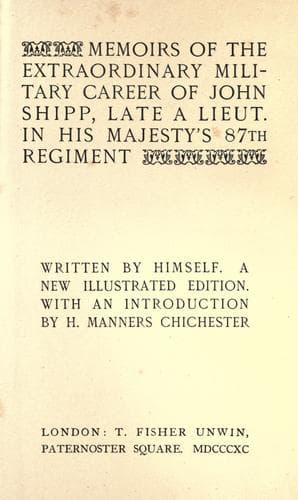
Memoirs of the Extraordinary Military Career of John Shipp: Late a Lieut. in His Majesty's 87th RegimentShipp, John
History
Memoirs of the Extraordinary Military Career of John Shipp: Late a Lieut. in His Majesty's 87th Regiment
Shipp, John
India -- History -- British occupation, 1765-1947 -- Biography; Shipp, John, 1784-1834
These were the people that the government of India wisely annihilated,
in the years 1817 and 1818. "In the destruction," says Sir John Malcolm,
"of this predatory system, which was converting the finest provinces
into a wilderness, the British government has performed a splendid act
of justice, policy, and humanity, which fairly entitles it to be
regarded as a conservative and beneficent power, whose supremacy has
been the deliverance of the people. That system was the baleful dregs of
the exhausted military establishment of the Mohammedan dynasties; and it
succeeded to the wars of Aurungzebe, like pestilence after famine,
rioting in the exhaustion of the country."
After a long and tedious march, we reached the fort of Dhamoony. The
rightful and proper owner of this extraordinary fort was the rajah of
Nagpore. He had, but a short period before, been placed on the
throne--so termed by the Indians--that is, in possession of his
inheritance, and acknowledged by the British government as the rightful
possessor, and their ally, and protected and guarded in quiet dominion,
when he suddenly entered into a league with the peishwah of Poonah, to
destroy the English, in violation of good faith, and to the disregard of
a most solemn treaty. When the Company were guarding and protecting this
treacherous rajah, he was harbouring in his bosom a plot of the most
base ingratitude. Such had been the secrecy with which he carried on his
intrigues with the peishwah, that a little band of British troops was
completely surrounded by fifty or sixty thousand horse, before the
Company were aware of his diabolical treachery. Our troops, in this
desperate situation, consisted of one regiment of native infantry, and a
few troops of the 5th regiment of Bengal native cavalry, in all not
seven hundred men, with, I believe, two six-pounders, against fifty or
sixty thousand! What was to be done? To stand and be shot at would have
been the height of folly and madness; nor could they, under such heavy
fire and force, hope to reach any other place of safety. Captain
Fitzgerald, commanding, or second in command of the 6th cavalry,
proposed charging the enemy, and selling their lives as dearly as
possible, declaring that, if he could gain a small eminence on which
they had a few guns, he should not despair of keeping them off and
saving their lives. In this proposal he was seconded by Mr. Jenkins, the
British resident at the court of Nagpore. The brave soldiers one and all
consented, and, sword in hand, on they galloped, and actually cut their
way through that immense mass of horsemen; in time gained the hill; took
their guns, and turned them upon the enemy; and there maintained their
post till reinforcements arrived. This piece of gallantry saved the
lives of all the party, and places on the brows of that brave corps
laurels that never can fade--honours of which the iron hand of time
cannot rob them. I have frequently met the officer who commanded on this
Public-domain text, read in full here on John Shaqi.
Reviews
Reviews
No reviews yet
Be the first to share your thoughts on this work.
Elsewhere in the archive
Join the Discussion
Join the discussion
Sign in to leave a comment or review.
Sign InorCreate an account