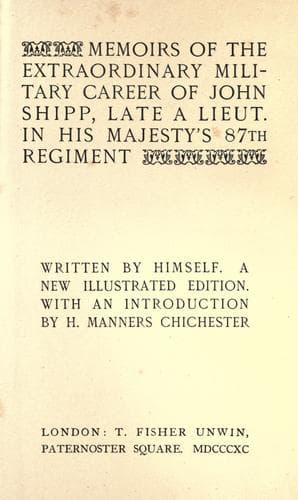
Memoirs of the Extraordinary Military Career of John Shipp: Late a Lieut. in His Majesty's 87th RegimentShipp, John
History
Memoirs of the Extraordinary Military Career of John Shipp: Late a Lieut. in His Majesty's 87th Regiment
Shipp, John
India -- History -- British occupation, 1765-1947 -- Biography; Shipp, John, 1784-1834
Behind the mortars lay some hundreds of shells, ready loaded, to be used
as they might be required; a shell, fired from one of the centre
mortars, burst in the muzzle; the fusee recoiled and fell on the loaded
shells; these exploded, and communicated with the magazine, which, at
that moment, a person had entered for the purpose of bringing out some
requisite. The explosion blew up this poor man, the unfortunate native
gunner before spoken of. It was more than twenty paces between the
magazine and the spot where this poor creature was found. In two days
after, he died. The melancholy event could not have been foreseen or
prevented; but the consequences were serious--sixteen men suffered, four
of them Europeans. Three of the victims were lying in the battery,
without their bodies having been even touched with gunpowder. They died
from concussion of the brain. One European was blown some yards into the
river, without the slightest injury. Conductor Glassop, of the Bengal
Foot Artillery, a man of upwards of twenty stone, was standing amidst
the shells when they blew up, and, strange to say, escaped uninjured.
Circumstances like these are the inscrutable doings of Providence, and
far beyond man's poor and narrow comprehension. At this time the general
had himself arrived, and having ascertained the cause of the sad
catastrophe, could only add his moiety of commiseration for the poor
sufferers. Blame could not be attached to anyone. The affair was one of
the unavoidable accidents of war, which no human foresight could have
guarded against or prevented.
The enemy, availing themselves of the calamity, rushed to that side of
the fort in great numbers, and brought every moveable gun and matchlock
to bear on the scene of woe. Having removed the dead and wounded to
camp, we reloaded the whole of the mortars and howitzers in the two
batteries, and levelled them at the multitude of people that had
collected on the fort. They were fired in quick succession, when a
general flight took place, and many of them ran their last race. Nearly
sixty shells, with some few shots, were fired in a few minutes, and not
a soul could for some time afterwards be seen at the same side of the
fort, save some few bearing away the dead and the wounded. We then gave
them three cheers, but they returned not the greeting.
At this moment our breaching-battery opened with a salvo, accompanied
with three hearty cheers, which that side of the garrison returned.
After this we went on coolly and systematically, and we returned home
again, visiting the several posts and batteries. In the evening, the
European soldiers were committed to the grave, followed by their
comrades, who dropped a tear to their memory.
Public-domain text, read in full here on John Shaqi.
Reviews
Reviews
No reviews yet
Be the first to share your thoughts on this work.
Elsewhere in the archive
Join the Discussion
Join the discussion
Sign in to leave a comment or review.
Sign InorCreate an account