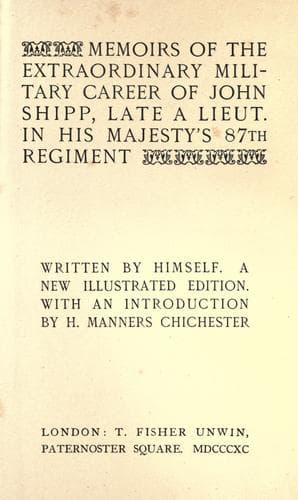
Memoirs of the Extraordinary Military Career of John Shipp: Late a Lieut. in His Majesty's 87th RegimentShipp, John
History
Memoirs of the Extraordinary Military Career of John Shipp: Late a Lieut. in His Majesty's 87th Regiment
Shipp, John
India -- History -- British occupation, 1765-1947 -- Biography; Shipp, John, 1784-1834
Ten o'clock came, but no messenger from the fort. A little time was
given, and the shelling-batteries did not re-commence till nearly eleven
o'clock; but when they did the top of the hill became one entire mass of
smoke and fire, and thus it continued till the afternoon, when a
messenger at length made his appearance, and informed the general that
the keeledar would be down immediately to ratify the treaty and give up
the fort. For this purpose the shelling was again stopped, and at about
two o'clock the keeledar began to descend in a palanquin, with three or
four followers. All the general and staff-officers in camp were directed
to assemble for the purpose of meeting this rebellious chief. General
Doveton's tent was the place of rendezvous. On the way to this tent the
people appointed to escort the keeledar took him through our park of
artillery, where there were some fifty guns, besides those then in use.
This keeledar was a most unseemly-looking man; a great fat buffalo of a
fellow, with enormous flitches of fat hanging over his hips. He was also
excessively dirty in his person and dress, and looked as if he had just
been turned out of an oil-shop. He entered the tent with all the
impudence of a nawab, chewing paun, and as though he was fully prepared
to receive a welcome greeting. In this he was disappointed. He was
desired to be seated, but his reception was cool and distant, and the
knitted brow of Major-General Sir John Malcolm, the political agent for
the government, portended no very flattering entertainment. When the
whole were seated, Sir John broke silence, by stating "that the British
army had no time to lose in unnecessary parley, and that, therefore, any
argument of his would be waste of words, and unavailing, as nothing
would suffice but the unconditional surrender of the fort to the troops
of his government, and that he should, in his person, answer to his
master, Scindia, for his rebellion and disloyalty." Here the fat
keeledar began to gather himself up into speaking order, and at last
mumbled out, that he was surprised that a person so well conversant with
the Eastern customs and usages of war should propose such a thing as
laying down their arms, as Sir John must know, that a rajah-poot would
sooner suffer ten thousand deaths than be deprived of his arms. He
concluded by protesting that for him to attempt to enforce such a thing
would be endangering his own life. Sir John replied that he did well
know the customs of the country and the characters of rajah-poot
soldiers; but the keeledar must keep in view that these were terms
offered to rebels, whose heads were the just forfeit of their
disobedience and rebellion, and that, therefore, if they persisted in
their rebellion, he should not advise the government to mitigate the
penalty a single jot, but to hang every one of them. This was pronounced
with some degree of displeasure, and the man of fat, not doubting in the
Public-domain text, read in full here on John Shaqi.
Reviews
Reviews
No reviews yet
Be the first to share your thoughts on this work.
Elsewhere in the archive
Join the Discussion
Join the discussion
Sign in to leave a comment or review.
Sign InorCreate an account