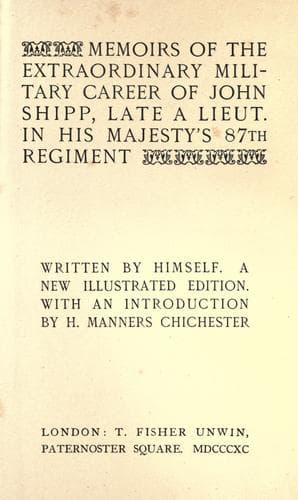
Memoirs of the Extraordinary Military Career of John Shipp: Late a Lieut. in His Majesty's 87th RegimentShipp, John
History
Memoirs of the Extraordinary Military Career of John Shipp: Late a Lieut. in His Majesty's 87th Regiment
Shipp, John
India -- History -- British occupation, 1765-1947 -- Biography; Shipp, John, 1784-1834
In the afternoon we went to examine the fort; and every step I took more
thoroughly convinced me of the utter impossibility of any earthly power
ever taking it by storm. I was obliged to halt a dozen times in
ascending, quite at my leisure, towards the grand entrance. By the time
I reached the gate I was completely exhausted, and I was ten minutes in
getting to the top. If we had stormed this place, it would, beyond
question, have been the grave of hundreds. On the walls were huge
stones, piled up for our destruction, some of them weighing two or three
hundred-weight, which a child might have pushed off. When once up, the
eye extended along a considerable level plain, on which were fields,
woods, and gardens. In the centre was a large tank of water, as clear as
crystal, but purple streams of blood lingered on its margins and banks.
Many dead bodies lay by the side of this tank. Some of them must have
been shot in the very act of drinking. The stench was dreadful. Their
sacred temple was contaminated and defiled with every kind of dirt and
filth, and their gods wore marks of disfigurement from our shells. One
had lost a head, but which, by the by, he could well spare, as he had a
dozen. In one of the excavations of the rock was discovered a woman
lying dead, with a dead infant in her arms. She was seated on a large
stone, with her right side reclining on another rock or side of the
excavation. Her left hand grasped the child round the body, and on her
right reclined her head. The head of the infant, which I should suppose
was about a year old, hung over her right knee. The woman had not a
bruise about her; but it was supposed she had fled there from those
destructive instruments of death, the shells. Near her lay several dead
and mutilated bodies, in a state of putrefaction. She was a young woman
about twenty, and well dressed. On inquiry among the prisoners, we
learned that her husband had been killed by one of our first shells, and
thrown into the very hole near which she was found, but it was not known
whether she had followed him there, or whether she died before him; for
the soldiers were so panic-struck that they could not directly answer
the most simple question. Behind the temple lay a headless trunk. We
understood that this was the body of the head priest of the said temple;
that he was boasting of his being proof against anything that could be
hurled against him by his hated foe; and, as we were informed by a
surviving mendicant, scarcely had the superstitious words escaped his
mouth, than he fell, a headless body, to the ground. His head, we were
told, was found some yards from the spot where he lay. We immediately
went in search of it, and found it eleven paces from the body, but not a
human feature was left. The face was literally torn to pieces. To sketch
the horrible scenes that presented themselves would fill a volume. I
shall mention but one more; a shell had burst between a man's legs, and
Public-domain text, read in full here on John Shaqi.
Reviews
Reviews
No reviews yet
Be the first to share your thoughts on this work.
Elsewhere in the archive
Join the Discussion
Join the discussion
Sign in to leave a comment or review.
Sign InorCreate an account