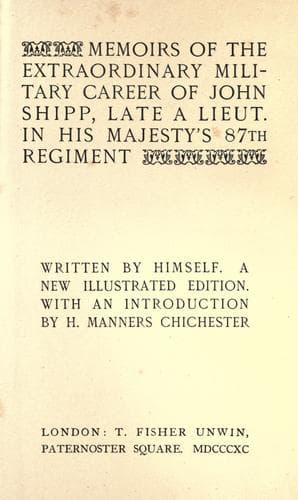
Memoirs of the Extraordinary Military Career of John Shipp: Late a Lieut. in His Majesty's 87th RegimentShipp, John
History
Memoirs of the Extraordinary Military Career of John Shipp: Late a Lieut. in His Majesty's 87th Regiment
Shipp, John
India -- History -- British occupation, 1765-1947 -- Biography; Shipp, John, 1784-1834
He was on one knee, and quite exhausted, having lost much
blood from his former wounds; but, to our great joy, we were just in
time to save him, and punish some of his assailants. From the intricacy
of the place, we were afraid of shooting our own men, and were therefore
obliged to keep pretty close together. At midnight I again met Captain
Lindsay, clearing one of the streets, when he asked me how I felt
myself. I complained of a wound in my side, but said that I could find
no hole; but this was not a time for talking. In turning sharp down a
street rather larger than those we had cleared, we met a column of the
enemy, with a person of rank in a palanquin. We soon stopped his black
highness; and, to ascertain who was inside the palanquin, which was an
open one, I, with several others, probed our way with our bayonets, when
a tremendous fat zemindar (an officer) roared out most lustily, and
began to show fight. He fired a matchlock at me, which went through the
wing of my coat, but did not touch my person. Before I could retaliate,
my comrades had finished him, and we then commenced at the column; but I
took from the palanquin the gun which had nearly robbed me of life. It
was like the barrel of a gun, about two feet long, with a round handle;
at the handle end was a sharp hatchet; at the other extremity a sharp hook.
This extraordinary instrument I presented to the commander-in-chief; but
he refused the present, saying it was my trophy. His lordship was
afterwards prevailed on to purchase it, at the price of two hundred
rupees. We at this time got information that the five companies which
had deserted from the Honourable Colonel Monson, in his masterly retreat
from Jeypore, were standing, dressed in the full uniform they deserted
in, outside the principal gate of the fort, with their arms ordered,
without apparently making any resistance, and frequently crying out,
"Englishmen, Englishmen, pray do not kill us; for God's sake, do not
kill us." As these supplications proceeded rather from fear than from
penitence for the crime they had been guilty of--that of deserting to an
enemy--these men could expect no mercy. We had positive orders to give
them no quarter, and they were most of them shot.
Public-domain text, read in full here on John Shaqi.
Reviews
Reviews
No reviews yet
Be the first to share your thoughts on this work.
Elsewhere in the archive
Join the Discussion
Join the discussion
Sign in to leave a comment or review.
Sign InorCreate an account