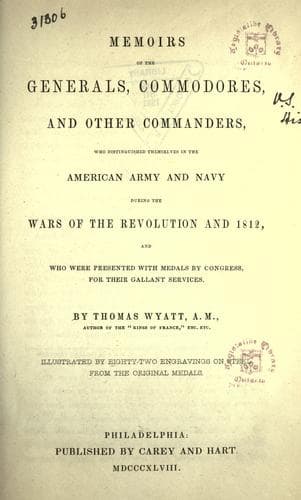
Memoirs of the Generals, Commodores and other Commanders, who distinguished themselves in the American army and navy during the wars of the Revolution and 1812, and who were presented with medals by Congress for their gallant servicesWyatt, Thomas
History
Memoirs of the Generals, Commodores and other Commanders, who distinguished themselves in the American army and navy during the wars of the Revolution and 1812, and who were presented with medals by Congress for their gallant services
Wyatt, Thomas
United States -- History -- Revolution, 1775-1783 -- Biography; United States -- History -- Revolution, 1775-1783 -- Medals; United States -- History -- War of 1812 -- Biography; United States -- History -- War of 1812 -- Medals
To this distinguished commander, Mr. Biddle entrusted the care of his
two sons, James and Edward, who, on obtaining midshipmen’s warrants,
were attached to the frigate President, fitting for the West Indies.
The cessation of hostilities with France brought the frigate again to
the United States after a much shorter cruise than was intended, but
which was rendered memorable by the melancholy death of Mr. Edward
Biddle, who died at sea of a fever after an illness of a few days.
Early in 1802, James Biddle sailed to the Mediterranean, in the frigate
Constellation, Captain Murray, to protect American commerce against
Tripolitan cruisers. This gave our young officer valuable opportunities
of renewing his acquaintance with classic writers, and remains of
antiquity, obtained by him during his studies at the University, and
which were to him an additional fund of instruction and gratification.
The Constellation returned home in 1803, and Mr. Biddle was transferred
to the frigate Philadelphia, Captain Bainbridge, and returned again to
the Mediterranean, where this unfortunate ship struck upon a rock, and
was lost.
When all efforts to get the Philadelphia afloat were found to be
unavailing, Lieutenant Porter and Midshipman Biddle were dispatched to
the commander to inform him of the accident. As they approached the
Tripolitan gun-boats, they were fired upon and ordered to surrender.
Porter and Biddle were prepared to deliver up their swords, but this
ceremony was dispensed with by the savage Tripolitans; twenty of whom,
of the most ferocious appearance, armed with sabres, pistols, and
muskets, jumped into the boat, and at once commenced their work of
insult and plunder. Two of them snatched Biddle’s sword, pulled off his
coat, and began to fight for it, when, to decide their dispute, they
returned it to him.
His cravat was violently torn from his neck, his waistcoat and shirt
torn open, in search for valuables that might be concealed about his
person. They searched all his pockets, and took all his papers and
money, except twenty dollars in gold, which he had slipped into his
boot and thereby secured. The officers and crew were then carried on
shore, conducted amidst the shouts and acclamations of a barbarous
rabble to the palace gates, and ushered into the presence of the
bashaw, who, seated in state, received them in the audience chamber;
and after asking a variety of questions about the American squadron,
they were conducted to the place assigned for safe keeping.
Reviews
Reviews
No reviews yet
Be the first to share your thoughts on this work.
Elsewhere in the archive
Join the Discussion
Join the discussion
Sign in to leave a comment or review.
Sign InorCreate an account