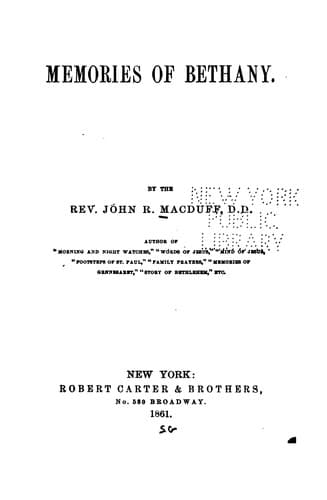
Jesus Christ -- Biography -- Sermons; Lazarus, of Bethany, Saint
The same writer, in another place (p. 450), says, "Even if the
evangelist had been less explicit in stating that He led them out 'as
far as to Bethany,' the secluded hills (that especially to which Tobler
assigns the name of Djebel Sajach) which overhang that village on the
eastern slope of Olivet, are evidently as appropriate to the whole tenor
of the narrative, as the startling, the almost offensive publicity of
the traditional spot, in the full view of the whole city of Jerusalem,
is wholly inappropriate, and (in the absence, as it now appears, of even
traditional support) wholly untenable."
[39] Acts i. 5.
[40] Acts i. 8.
[41] John xvi. 7.
[42] John xvi. 14.
[43] Acts i. 6, 7.
[44] Acts i. 8.
[45] Luke xxiv. 50.
[46] Ps. lxviii. 18.
[47] Montgomery.
[48] "Within and Without."
[49] Acts i. 11.
[50] Is it lawful to think of Bethany in connexion with the Church of
the Future? Are there no foreshadowed glories found in the pages of Holy
Writ, which include this lowly village--gilding it with the beams of a
Millennial Sun? Is it destined to remain as it now is--a wreck of
vanished loveliness? and is the crested ridge above it, which was the
scene of the great terminating event of the Incarnation, to be
associated with no other august displays of the Redeemer's power and
majesty? The following remarkable prediction occurs in the prophet
Zechariah:--"_And his feet shall stand in that day upon the mount of
Olives, which is before Jerusalem on the east, and the mount of Olives
shall cleave in the midst thereof toward the east and toward the west,
and there shall be a very great valley; and half of the mountain shall
remove toward the north, and half of it toward the south._" Zech. xiv.
4. Were we of the number of those--(perhaps some who read these
pages)--who look with firm and joyful confidence to the Personal Reign
of the Redeemer on earth, and who in their code of interpretation
regarding unfulfilled prophecy, espouse the literal in preference to the
spiritual meaning, we might here have an inviting picture presented to
us of the BETHANY of the future. The Mount of Olives, by some great
physical, or rather supernatural agency, is represented as heaving from
its foundations, and parting in twain. The middle summit disappears. The
remaining two form the steep sides of a new Valley, which, as it is
spoken of as opening at Jerusalem (from Gethsemane), eastwards, the
Vista must necessarily terminate with BETHANY; thus connecting the two
most memorable spots associated with our Lord's humiliation. "His feet
shall stand in that day on the _Mount of Olives_."--The once lowly
Saviour again "stands" in power and great glory on the very spot over
Bethany from which He formerly ascended. A new highway from the "Village
of Palms" is made for His triumphal entrance to the Holy City, while the
air resounds with the old welcome--"Rejoice, O daughter of Zion, behold
thy King cometh!" If further we turn with the literalists to the
Public-domain text, read in full here on John Shaqi.
Reviews
Reviews
No reviews yet
Be the first to share your thoughts on this work.
Elsewhere in the archive
Join the Discussion
Join the discussion
Sign in to leave a comment or review.
Sign InorCreate an account