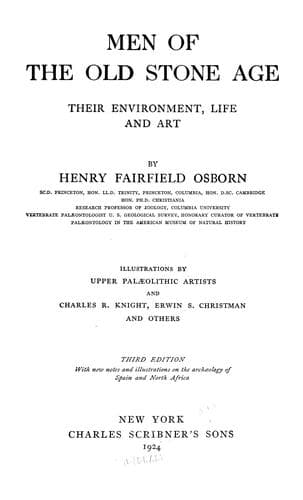
Men of the Old Stone Age: Their Environment, Life and ArtOsborn, Henry Fairfield
History
Men of the Old Stone Age: Their Environment, Life and Art
Osborn, Henry Fairfield
Art, Primitive; Prehistoric peoples; Stone age
The jaw presents profoundly different characters; the whole of the bone
preserved closely resembles that of a young chimpanzee; thus the slope of
the bony chin as restored is between that of an adult ape and that of the
Heidelberg man, with an extremely receding chin; the ascending portion of
the jaw for the attachment of the temporal muscles is broad and thickened
anteriorly. Associated with the jaw were two elongated molar teeth, worn
down by use to such an extent that the individual could not have been less
than thirty years of age and was probably older. These teeth are
relatively longer and narrower than those in the modern human jaw. The
canine tooth, identified by Smith Woodward as belonging in the lower jaw,
strengthened by the evidence afforded by the jaw itself, proves that the
face was elongate or prognathous and that the canine teeth were very
prominent like those of the anthropoid apes; it affords definite proof
that the front teeth of the Piltdown man resembled those of the ape.
The author's conclusion is that while the skull is essentially human, it
approaches the lower races of man in certain characters of the brain, in
the attachment of the muscles of the neck, in the large extent of the
temporal muscles attached to the jaw, and in the probably large size of
the face. The mandible, on the other hand, appears precisely like that of
the ape, with nothing human except the molar teeth, and even these
approach the dentition of the apes in their elongate shape and
well-developed fifth or posterior intermediate cusp. This type of man,
distinguished by the smooth forehead and supraorbital borders and ape-like
jaw, represents a new genus called _Eoanthropus_, or 'dawn man,' while the
species has been named _dawsoni_ in honor of the discoverer, Charles
Dawson. This very ancient type of man is defined by the ape-like chin and
junction of the two halves of the jaw, by a series of parallel
grinding-teeth, with narrow lower molar teeth, which do not diminish in
size backward, and by the steep forehead and slight development of the
brow ridges. The jaw manifestly differs from that of the Heidelberg man in
its comparative slenderness and relative deepening toward the symphysis.
The discussion of this very important paper by Smith Woodward and Dawson
centred about two points. First, whether the ape-like jaw really belonged
with the human skull rather than with that of some anthropoid ape which
happened to be drifted down in the same stratum; and second, whether the
extremely low original estimate of the brain capacity of 1070 c.cm., was
not due to incorrect adjustment or reconstruction of the separate pieces
of the skull.
Public-domain text, read in full here on John Shaqi.
Reviews
Reviews
No reviews yet
Be the first to share your thoughts on this work.
Elsewhere in the archive
Join the Discussion
Join the discussion
Sign in to leave a comment or review.
Sign InorCreate an account