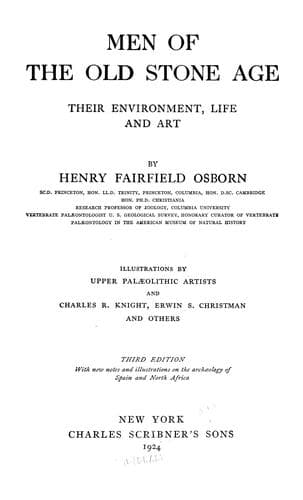
Men of the Old Stone Age: Their Environment, Life and ArtOsborn, Henry Fairfield
History
Men of the Old Stone Age: Their Environment, Life and Art
Osborn, Henry Fairfield
Art, Primitive; Prehistoric peoples; Stone age
The mammalian life which we find with the more advanced implements of
Chellean times apparently does not include the old Pliocene mammals, such
as the Etruscan rhinoceros and the sabre-tooth tiger. With this exception
it is so similar to that of Second Interglacial times that it may serve to
prove again that the third glaciation was a local episode and not a
wide-spread climatic influence. This life is everywhere the same, from
the valley of the Thames, as witnessed in the low river-gravels of
Gray's Thurrock and Ilford, to the region of the present Thuringian
forests near Weimar, where it is found in the deposits of Taubach,
Ehringsdorf, and Achenheim, in which the mammals belong to the more recent
date of early Acheulean culture. The life of this great region during
Chellean and early Acheulean times was a mingling of the characteristic
forest and meadow fauna of western Europe with the descendants of the
African-Asiatic invaders of late Pliocene and early Pleistocene times.
[Illustration: PL. IV. The Piltdown man of Sussex, England. Antiquity
variously estimated at 100,000 to 300,000 years. The ape-like structure of
the jaw does not prevent the expression of a considerable degree of
intelligence in the face. After the restoration modelled by J. H.
McGregor.]
Southern mammoth.
Hippopotamus.
Straight-tusked elephant.
Broad-nosed rhinoceros.
Spotted hyæna.
Lion.
Bison and wild ox.
Red deer.
Roe-deer.
Giant deer.
Brown bear.
Wolf.
Badger.
Marten.
Otter.
Beaver.
Hamster.
Water-vole.
The forests were full of the red deer (_Cervus elaphus_), of the roe-deer
(_C. capreolus_), and of the giant deer (_Megaceros_), also of a primitive
species of wild boar (_Sus scrofa ferus_) and of wild horses probably
representing more than one variety. The brown bear (_Ursus arctos_) of
Europe is now for the first time identified; there was also a primitive
species of wolf (_Canis suessi_).
The small carnivora of the forests and of the streams are all considered
as closely related to existing species, namely, the badger (_Meles
taxus_), the marten (_Mustela martes_), the otter (_Lutra vulgaris_), and
the water-vole (_Arvicola amphibius_). The prehistoric beaver of Europe
(_Castor fiber_) now replaces the giant beaver (_Trogontherium_) of Second
Interglacial times.
Public-domain text, read in full here on John Shaqi.
Reviews
Reviews
No reviews yet
Be the first to share your thoughts on this work.
Elsewhere in the archive
Join the Discussion
Join the discussion
Sign in to leave a comment or review.
Sign InorCreate an account