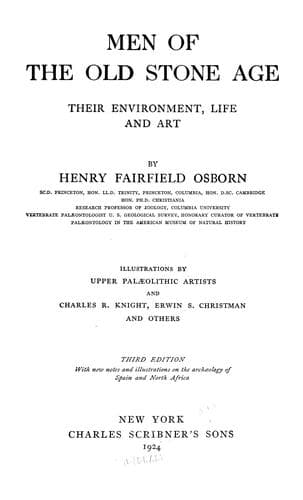
Men of the Old Stone Age: Their Environment, Life and ArtOsborn, Henry Fairfield
History
Men of the Old Stone Age: Their Environment, Life and Art
Osborn, Henry Fairfield
Art, Primitive; Prehistoric peoples; Stone age
The _chef-d'œuvre_ of the late Acheulean industry is the Levallois flake,
first found at Levallois-Perret, near Paris, which de Mortillet believed
to be fashioned out of a divided coup de poing with a flat under-side,
but which may have been evolved from the very large primitive flakes of
Pre-Chellean date. These flakes date back earlier than the Chellean coup
de poing but continued in use after its invention and may have been
greatly perfected into the Levallois type. This type of 'couteau' is a
large, wide, thin flake of fairly symmetrical shape, with a flat back
formed by the original smooth surface of the flake. These implements are
pointed, oval, or sharply rectangular in form and present the most
characteristic tool of the closing stage of the Acheulean industry.
It is most interesting at this point to observe the two modes of evolution
which seem to pervade all nature: first, the gradual perfection and
modification in size and proportion of a certain older form; second, the
sudden change or mutation into a new form, which in turn enters the stage
of gradual improvement.
The late Acheulean is seen to present the climax of a gradual and unbroken
development from the early Chellean industries and ideas; and to our mind
this is strongly suggestive of a corresponding evolution of manual skill
and mental development in the workmen themselves, who may have been partly
of Pre-Neanderthaloid race.
The next industrial stage, namely, the Mousterian, which certainly
presents the closing workmanship of the Neanderthal race, shows a marked
retrogression of technique in contrast to the steady progression which we
have observed up to this time. We have, in fact, witnessed a number of
successive stages of progression, which are to be followed in the
Mousterian by a stage of retrogression. Such a retrogression in industrial
development may for certain known or unknown reasons occur in the same
race. It is a noteworthy parallel that in the Upper Palæolithic, where the
Solutrean culture represents the climax and perfection of flint working,
the succeeding Magdalenian shows marked retrogression in the technique of
flint retouch.
THE KRAPINA NEANDERTHALOIDS
Public-domain text, read in full here on John Shaqi.
Reviews
Reviews
No reviews yet
Be the first to share your thoughts on this work.
Elsewhere in the archive
Join the Discussion
Join the discussion
Sign in to leave a comment or review.
Sign InorCreate an account