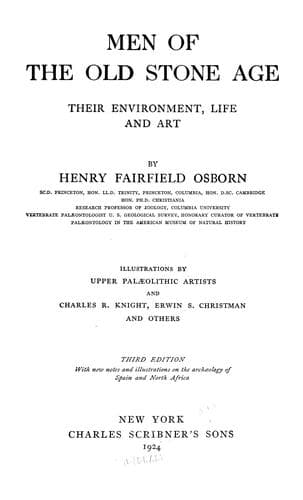
Men of the Old Stone Age: Their Environment, Life and ArtOsborn, Henry Fairfield
History
Men of the Old Stone Age: Their Environment, Life and Art
Osborn, Henry Fairfield
Art, Primitive; Prehistoric peoples; Stone age
The three successive phases of climate and environment surrounding the
Neanderthal men during the period of the development of the Mousterian
industry, were in descending order as follows:
3. _Extreme Cold Climate of the Last Great Glacial Advance._ Period of
the late Mousterian industry of La Quina. Spread of all the arctic and
tundra mammals over western Europe, including the musk-ox; migrations
of the obi and banded lemming of the extreme north. Life and industry
of the Neanderthal races, chiefly in the shelters, grottos, and
entrances to the caverns.
2. _Cold Moist Climate._ Period of the middle or 'full Mousterian'
industry of the Neanderthal races. Appearance of the tundra life,
including well-protected mammals and birds from the arctic region,
also descent of the Alpine types to the foot-hills and river borders.
First forerunners of the steppe life; the full Eurasiatic forest and
field life widely spread over Europe. Life and industry chiefly in
the shelters, grottos, and entrances to the caverns. Reindeer very
abundant.
1. _Warm or Cool Arid Climate._ Transition from the Acheulean to the
early Mousterian culture, as observed in the stations of La Micoque
and of Combe-Capelle. The so-called 'warm Mousterian' fauna, including
the surviving hippopotamus, Merck's rhinoceros, and the
straight-tusked elephant in northern and southern France; herds of
bison, cattle, and wild horses in southwestern France. Tribal life,
with the industry partly in open stations, partly under sheltering
cliffs.
This is the beginning of the 'Reindeer Period,' for this migrant from
Scandinavia, with its companions of the northeastern tundras, the woolly
mammoth and the rhinoceros, wandered slowly southward before the advancing
Scandinavian ice-fields, which were greatly augmented by the increasingly
cold and moist climate. Thus these animals are found in the north with
flints of the Mousterian culture before they appear in the more genial
region of Dordogne. In the somewhat older Acheulean-Mousterian station of
La Micoque, along the Vézère, the fire-hearths contain almost exclusively
the remains of horses and relatively few remains of bison and wild cattle,
but no reindeer. A fireplace near the station of Combe-Capelle yields
numerous remains of the bison, only a few of the horse, and the first of
the reindeer. Before the appearance of the reindeer in the valley of the
Vézère we may picture the meadow-lands as covered with bison and wild
horses, the latter of the type which is now characteristic of the high
plateaus of central Asia, while the bison of the period appears to be more
similar to the American buffalo than to the surviving European form.
Public-domain text, read in full here on John Shaqi.
Reviews
Reviews
No reviews yet
Be the first to share your thoughts on this work.
Elsewhere in the archive
Join the Discussion
Join the discussion
Sign in to leave a comment or review.
Sign InorCreate an account