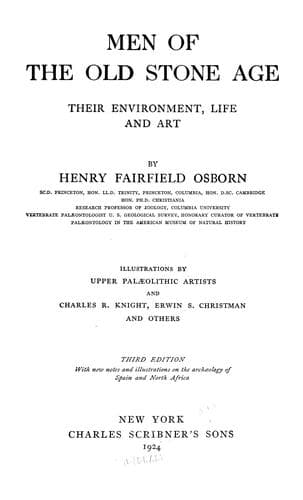
Men of the Old Stone Age: Their Environment, Life and ArtOsborn, Henry Fairfield
History
Men of the Old Stone Age: Their Environment, Life and Art
Osborn, Henry Fairfield
Art, Primitive; Prehistoric peoples; Stone age
While the remains of the woolly mammoth are found here, there are also
indications of the presence of a well-marked temperate flora. These
high-level 'river-drifts' along the Thames(18) were certainly deposited
when the climatic conditions were temperate, but they are succeeded by
deposits indicating a renewed cold period, which may represent the cold
'full Mousterian' times of the Lower Palæolithic habitation of the Thames.
Here we find the remarkable sheets of contorted 'drift' attributable to
the movements of the frozen soil and subsoil when exposed to the heat of
the summer sun. At the same time there may have been deposited along the
Thames the alluvial loams and gravels, occasionally containing stones and
rocks, which were brought down by ice-rafts; these low-level gravels are
not to be confused with the underlying 'old river-gravels' which contain
the warm temperate hippopotamus fauna, for they were accumulated under
very cold conditions; they yield remains of the woolly rhinoceros and of
the mammoth. Thus, on the high levels of the Thames as well as on the low
levels we find evidences of the human culture and of the extinct fauna of
the period of the fourth great glaciation.
[Illustration: FIG. 100. Mousterian cavern of Wildkirchli. After Bächler.
Entrances indicated at 1, 2, and 3, in the side of the limestone cliff.
Here, at a height of 4,500 feet above sea-level, Bächler discovered proofs
of occupation by Mousterian man in the very heart of the Alpine ice-fields
of the Fourth Glacial Stage.]
The upper waters of the Rhine and Danube were also frequented by late
Acheulean and early Mousterian flint workers. At a point far distant from
southern England there is the cavern of Wildkirchli on the Santis
Mountains, near Appenzell, in Switzerland; in Mousterian times this was in
the very heart of the north Alpine ice-field. The animal life here may
indicate that this cavern was open during the period of recession between
the two great advances of the fourth glaciation. Here, at a height of
4,500 feet, Bächler(19) between 1903-6, discovered proofs of occupation by
Neanderthal man during Mousterian times; the flints are not well formed;
the presence of crude bone implements may point to late Mousterian times;
but the flints are considered by Bächler to be of the same stage as those
of Le Moustier. It is asserted that when the Neanderthals followed the
chase here the climate was more genial, because the animals found include
the stag, Alpine wolf (_Cyon alpinus fossilis_), cave-bear, cave-lion,
cave-leopard (_Felis pardus spelæa_), badger, marten, and otter, together
with the typical Alpine forms, the ibex, chamois, and marmot. But this
fauna alone can hardly be taken as proof of a temperate climate, for at
this Alpine height we should not expect to discover the tundra life of the
period; in fact, it is entirely absent.
Public-domain text, read in full here on John Shaqi.
Reviews
Reviews
No reviews yet
Be the first to share your thoughts on this work.
Elsewhere in the archive
Join the Discussion
Join the discussion
Sign in to leave a comment or review.
Sign InorCreate an account