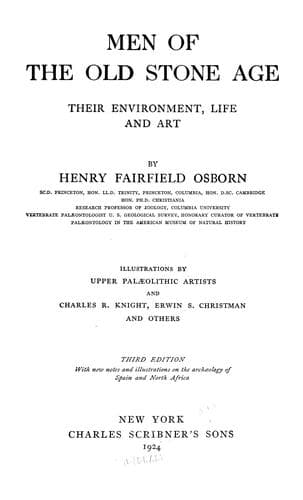
Men of the Old Stone Age: Their Environment, Life and ArtOsborn, Henry Fairfield
History
Men of the Old Stone Age: Their Environment, Life and Art
Osborn, Henry Fairfield
Art, Primitive; Prehistoric peoples; Stone age
This is the life of the period of the fourth glaciation, when a very cold
and moist climate prevailed all over western Europe as far south as
northern Spain and northern Italy. While the glacial fields were not so
extensive as during the third or the second glaciation, the climate was
very severe, as indicated by the southward migration not only of the
arctic flora but of the mammals and birds of the tundra region bordering
the southern shores of the Arctic Ocean. Two or three forms from the cold
steppes of northern Russia also found their way into western Europe,
but this was distinctly not a steppe period because of the prevailing
moisture of the climate; in place of the westerly winds and great dust
clouds of closing Acheulean times, cold mists and clouds heavy with
moisture swept over the country, which during the winters was at times
buried in snow, and subject to rapid changes of temperature. These
climatic[AG] conditions appear to be demonstrated by the predominance of
the arctic tundra life, mammals which were adapted only to severe weather
and attracted by the northern flora.
[Illustration: PL. V. The Neanderthal man of La Chapelle-aux-Saints,
inhabiting the Dordogne region of central France in Mousterian times.
Antiquity estimated as between 40,000 and 25,000 years. After the
restoration modelled by J. H. McGregor. For the bodily proportions of this
hunting race compare the frontispiece, Pl. I.]
The summers were undoubtedly warm like the present Arctic summers, but
very much longer in these southerly latitudes. It is not improbable that
there were seasonal migrations, northward and southward, of the mammoths,
rhinoceroses, and reindeer, and also that the northern flint quarries
along the Somme and the Marne may have been visited chiefly during the
warm summer season. The Asiatic mammals had entirely disappeared from the
regions of France and Germany during the first maximum of the fourth
glaciation, but there are some who maintain that during the amelioration
of climate that followed, an interval in the Alpine region termed the
_Laufenschwankung_ by Penck, the straight-tusked elephant and Merck's
rhinoceros again migrated into northern France. It is true that
occasionally we find the bones of these animals in close association with
those of the woolly mammoth and the woolly rhinoceros. It is possible to
explain such intermingling either as having occurred during the advance of
the fourth glaciation, or as due to the northward and southward migration
of the respective herds of mammals in the summer and winter seasons. As
the period of the fourth glaciation continued it is certain that these
Asiatic mammals entirely disappeared.
At the same time the Neanderthals had passed through the first stage of
development of the Mousterian industry and had reached what is known as
the 'full' or 'high' Mousterian, which, with few exceptions, was carried
on under the shelter of the overhanging cliffs or within the grottos.
Public-domain text, read in full here on John Shaqi.
Reviews
Reviews
No reviews yet
Be the first to share your thoughts on this work.
Elsewhere in the archive
Join the Discussion
Join the discussion
Sign in to leave a comment or review.
Sign InorCreate an account