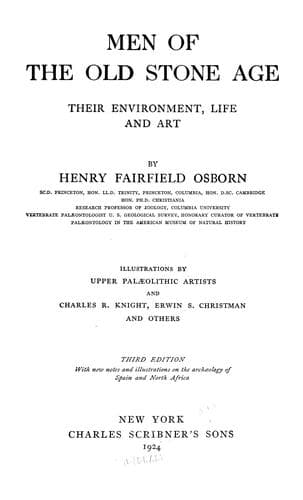
Men of the Old Stone Age: Their Environment, Life and ArtOsborn, Henry Fairfield
History
Men of the Old Stone Age: Their Environment, Life and Art
Osborn, Henry Fairfield
Art, Primitive; Prehistoric peoples; Stone age
The open-air or nomadic life of all the tribes of western Europe from
Pre-Chellean nearly to the close of Acheulean times was very unfavorable
to the preservation of human remains. It is possible that the bodies of
the dead and of the aged were thrown out to the hyænas which surrounded
the stations, as among some of the tribes of Africa to-day, but it is
equally possible that they were interred in some manner. Skeletons buried
near the surface in the river sands or gravels of the 'terraces' would not
have been preserved. We have seen that the preservation of the Heidelberg
and Piltdown remains was entirely due to chance, the bones having been
washed down and mingled with those of the animals; nor has any evidence
been found in the grotto of Krapina of ceremonial burial or of respect for
the dead, but on the contrary there is some evidence of cannibalistic
customs. Even before the close of early Mousterian times all this was
changed. Perhaps the closer association enforced by the more rigorous
climate indirectly produced greater respect for the dead and led to the
custom of burial or the orderly laying out of the remains of the dead in
the floors of the partly protected grottos and caverns, to which custom we
owe our present knowledge of the structure of Neanderthal man in
Mousterian times.
[Illustration: FIG. 105. Front view of the Neanderthaloid skull found at
Gibraltar in 1848--the earliest discovery of a member of this race, now
regarded as the skull of a woman. Photograph by A. Hrdlička from the
original specimen. One-quarter life size.]
The first discovery of a Neanderthaloid was made in 1848, eight years
before the type of the Neanderthal race came to light. This was the
Gibraltar skull(26) found by Lieutenant Flint, near Forbes Quarry, on the
north face of the Rock of Gibraltar. It consists of a well-preserved
skull, with the parietal bones only missing and the face and base of the
cranium remarkably complete. In 1868 it was presented by Busk to the
Museum of the Royal College of Surgeons, in London, where it lies to-day.
The exact site of the discovery can no longer be positively identified; it
was probably found in a still existing cave, and although its archæologic
age cannot be determined, yet as its anatomical features are those of the
Neanderthal race, and as all the remains of this race which can be dated
with certainty are of Mousterian age, it probably belongs to the
Mousterian period. Of recent years its great importance in the history of
man has been revealed in the studies of Sollas, Keith, and Schwalbe. Thus
it has come to be ranked among the Neanderthaloids and is considered of a
particularly primitive form, because of the extremely small size of the
brain. This feature and the slight development of the supraorbital ridges,
so characteristic of the Neanderthaloids, are explained by the theory that
the skull belonged to a female.
Public-domain text, read in full here on John Shaqi.
Reviews
Reviews
No reviews yet
Be the first to share your thoughts on this work.
Elsewhere in the archive
Join the Discussion
Join the discussion
Sign in to leave a comment or review.
Sign InorCreate an account