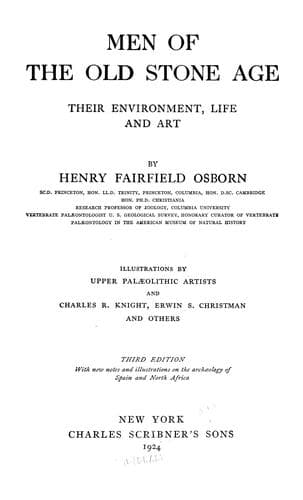
Men of the Old Stone Age: Their Environment, Life and ArtOsborn, Henry Fairfield
History
Men of the Old Stone Age: Their Environment, Life and Art
Osborn, Henry Fairfield
Art, Primitive; Prehistoric peoples; Stone age
In many characteristics the Neanderthal skull is shown to be nearer to
that of the anthropoid apes than to that of _Homo sapiens_. This
conclusion arrived at by Schwalbe, in 1901,(57) has been more than
confirmed by Boule's masterly study(58) of the very complete skull of La
Chapelle. After his detailed review, he concludes: As to the unity of the
Neanderthal head form, these features are not peculiar to the skull of La
Chapelle; in every case they are also found in the skulls of Neanderthal,
Gibraltar, Spy, Krapina, La Ferrassie, which witness to the homogeneity of
that human fossil type called Neanderthal. These features show a
structural affinity between the fossil men of the Mousterian period and
the anthropoid apes. It must be noted that many of these features may be
found also in recent human skulls of the inferior races, but that they are
very rare, very scattered, very isolated, and occur only as aberrations.
It is the accumulation of all these features in every skull of a whole
series which constitutes an assemblage entirely new and of great
importance. In the skull, as in other parts of the anatomy of the
Neanderthals, we should not expect to find every character intermediate
between the anthropoids and recent man. The long Neanderthal face is
somewhat similar to that of the Eskimo and is in contrast with the very
short face of the existing Australians and Tasmanians. The depression at
the root of the nose, just below the glabella, is very marked in all
Neanderthals; there is less of the nose bridge than in any recent races,
except those of the male Australians, yet the nose is not flattened but
somewhat arched or aquiline. This feature is not characteristic of all the
anthropoid apes, and in this respect the Neanderthals, Australians, and
Tasmanians are more different from the anthropoid apes than are some of
the white races; thus the Neanderthal nose, far from resembling that of
the anthropoids, differs from it more than does that of some recent human
types.(59) Many anatomists, following Huxley, have described the
Australian and Tasmanian skulls as more or less Neanderthaloid, and some
authors have gone so far as to regard these races as surviving
Neanderthals. It is true that some of the skulls in these existing races
are extraordinarily platycephalic and show a retreating forehead, that
others show supraorbital ridges almost as prominent as in the
Neanderthals, that sometimes the prominence of the occipital inion is very
marked, that certain jaws show a very retreating chin. Thus one or another
of these Neanderthal features has been observed in these lower existing
races, but all of these characteristics have never been combined in one
race as constant features, and invariably associated, as in all the skulls
of the Neanderthals known to us.
Public-domain text, read in full here on John Shaqi.
Reviews
Reviews
No reviews yet
Be the first to share your thoughts on this work.
Elsewhere in the archive
Join the Discussion
Join the discussion
Sign in to leave a comment or review.
Sign InorCreate an account