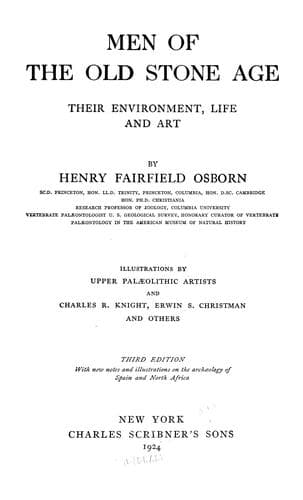
Men of the Old Stone Age: Their Environment, Life and ArtOsborn, Henry Fairfield
History
Men of the Old Stone Age: Their Environment, Life and Art
Osborn, Henry Fairfield
Art, Primitive; Prehistoric peoples; Stone age
The structure of the shoulder and of the chest is full of interest. All
the ribs are remarkably robust and of large volume, and, whereas in
existing races they exhibit a flattened section, in the Neanderthals the
section is distinctly triangular in form. This implies a very muscular and
robust torso in correlation with the gigantic head and stout limbs. The
collar-bones are correspondingly long, presenting a ratio to the humerus
exceeding 54 per cent, which is much higher than that among the average
existing races; this indicates a very broad shoulder. The shoulder-blade
is also very different in type from that of the higher races of men, and
even from that of the higher Primates; it is extremely short and broad.
While, as noted above, the arm of the Neanderthals is relatively short and
thus non-anthropoid, it presents a mingling of human and ape characters.
The upper arm, or humerus, is truly of the human type, the torsion angle
upon its axis being 148°, whereas in the anthropoid apes the angle of
torsion never passes 141°. Among the bones of the lower arm the most
significant is the radius, with which the turning movement of the hand is
correlated; the structure of the head of the radius has more resemblance
to that of the anthropoid apes than to that of existing species of man.
The structure of the other bone of the forearm, the ulna, is also very
primitive, exhibiting certain monkey characteristics.
[Illustration: FIG. 122. Thigh-bones, or _femora_, of the Trinil,
Neanderthal, and Crô-Magnon races, compared with one of modern type. The
Neanderthal femur seems to be short and stout, whereas that attributed to
_Pithecanthropus_ is relatively long, slender, and straight. Of the
_femora_ illustrated the Neanderthal and Trinil are those of the type
specimens, the Crô-Magnon is from the skeletal fragments of La Madeleine.
After Dubois, Boule, Lartet, and Christy. One-eighth life size.]
The structure of the hand is a matter of the highest interest in
connection with the implement-making powers of the Neanderthals. The hand
is remarkably large and robust, comparable in size with that of men of
very large stature in existing races. With respect to the opposition power
of the thumb against the fingers by means of the opponens muscle, a
distinctively human characteristic, the stage of Neanderthal development
is decidedly lower than that of existing races, because the joint of the
metacarpal bone which supports the thumb is of a peculiar form, convex,
and presenting a veritable convex condyle, whereas in the existing human
races the articular surface of the upper part of the thumb joint is
saddle-shaped, that is, concave from within backward, and convex from
without inward. Thus the highly perfected motions of the thumb in _Homo
sapiens_ were not attained in _Homo neanderthalensis_. Two phalanges which
are preserved in the Chapelle-aux-Saints skeleton show that the fingers
were relatively short and robust.
Public-domain text, read in full here on John Shaqi.
Reviews
Reviews
No reviews yet
Be the first to share your thoughts on this work.
Elsewhere in the archive
Join the Discussion
Join the discussion
Sign in to leave a comment or review.
Sign InorCreate an account