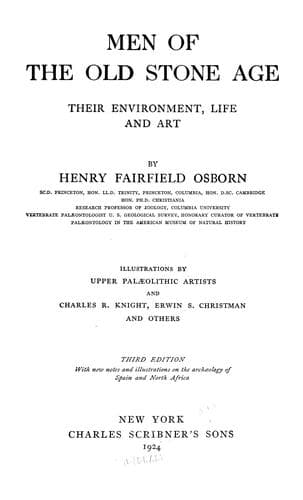
Men of the Old Stone Age: Their Environment, Life and ArtOsborn, Henry Fairfield
History
Men of the Old Stone Age: Their Environment, Life and Art
Osborn, Henry Fairfield
Art, Primitive; Prehistoric peoples; Stone age
The successive stages of the Mousterian industry have not as yet been so
clearly defined as those of the Acheulean (Schmidt(70)). In the open
Mousterian stations and caverns of Belgium and England Schmidt has
observed the stages of early, middle, and late Mousterian. Breuil and
Obermaier consider La Micoque as belonging to the close of the Acheulean
but as marking the transition into the Mousterian. Breuil considers the
industry of the Combe-Capelle station as representing the oldest true
Mousterian culture. The researches which have been carried thus far would
appear to justify the following subdivisions of the Mousterian culture in
southwestern France:
6. Abri Audit culture, marking the transition from late Mousterian to
early Aurignacian industry.
5. Late true Mousterian industry. La Quina type of implements with
scrapers and bone anvils.
4. Middle Mousterian industry, with a predominance of handsome, large
Mousterian points carefully 'retouched' on the edge and sometimes on
one side, a 'retouch' at times approaching the superior Solutrean
technique.
3. Primitive early Mousterian industry, with a limited inventory of
implements.
2. Combe-Capelle stage, with heart-shaped coups de poing and typical
Mousterian 'points.' (Arrival of reindeer.)
1. La Micoque culture, transitional from Acheulean to Mousterian
times. (No reindeer.)
The flint industry, although very different in its outward appearance, is
recognizable as a direct evolution from the Acheulean, with the
suppression or decline of certain implements and the improvements of
others. It is the product of the same kind of mind at work with the same
materials, but under different climatic conditions and with new demands,
especially for clothing as protection against the severe weather. We also
cannot avoid the feeling that the abandonment of the free, open life of
Chellean and early Acheulean times and the crowding of the Neanderthal
tribesmen beneath the shelters and in the grottos had a dwarfing effect
both upon the physique and upon the industry itself. The Mousterian
implements, as compared with the Acheulean, impress one as the work of a
less muscular and vigorous race.
Public-domain text, read in full here on John Shaqi.
Reviews
Reviews
No reviews yet
Be the first to share your thoughts on this work.
Elsewhere in the archive
Join the Discussion
Join the discussion
Sign in to leave a comment or review.
Sign InorCreate an account