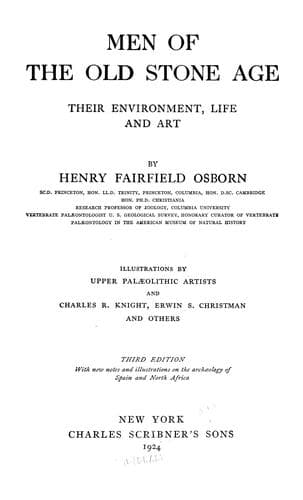
Men of the Old Stone Age: Their Environment, Life and ArtOsborn, Henry Fairfield
History
Men of the Old Stone Age: Their Environment, Life and Art
Osborn, Henry Fairfield
Art, Primitive; Prehistoric peoples; Stone age
4. Interval between the _Bühl_ and _Gschnitz_ Postglacial advances in
the Alps. A renewed steppe and 'loess' period. Climate cold and dry.
Mammoth and woolly rhinoceros, reindeer, full tundra and steppe fauna
very abundant. Crô-Magnon race in the stage of MIDDLE MAGDALENIAN
culture.
3. The _Bühl_ stage of Postglacial advance in the Alps; renewal of
severe conditions of cold moist climate, and spread all over western
Europe of the arctic banded and Obi lemmings of the _Upper Rodent
Layer_. _Bühl_ moraines in Lake Lucerne estimated as having been
deposited between 16,000 and 24,000 years B. C. Crô-Magnon race
dominant in the EARLY MAGDALENIAN stage of culture.
2. Period of the first Postglacial interval or _Achen_ retreat of the
glaciers in the Alpine region. A dry cold climate. Crô-Magnon and
Brünn races in the stage of SOLUTREAN culture.
1. Close of fourth glaciation, between 24,000 and 40,000 years B. C.
Cold and moist but increasingly dry climate succeeding the fourth
glaciation and deposition of _Lower Rodent Layer_, or first invasion
of the arctic tundra rodents. Crô-Magnon and possibly Aurignacian race
in the stage of AURIGNACIAN culture.
BEGINNING OF THE UPPER PALÆOLITHIC
THE AURIGNACIAN INDUSTRY
We now glance at western Europe as it was between 25,000 and 30,000 years
ago, at the opening of the Upper Palæolithic.
During Aurignacian times France was still broadly connected with Great
Britain.(11) The British Islands were not only united with each other but
with the continent, while the elevation of the Scandinavian peninsula
converted the Baltic Sea into a great fresh-water lake, the old shores of
which are readily traced. Geikie also maintains that the rise of land in
Scotland after the fourth glaciation was accompanied by an amelioration of
climate and the advent of more genial conditions; a strong forest growth
covered the lowlands, hence this is termed the _Lower Forestian_ stage of
the physiographic history of northern Britain; it corresponds to the
temporary period of the retreat of the glaciers in the Alpine region,
which Penck has named the _Achenschwänkung_. The latter author is not
inclined to connect any marked rise of temperature in the Alpine region
with this interval of time; to our knowledge no fossil plant beds have
been preserved which would give us such indications, and the animal life,
as we shall see, certainly affords only a very slight indication of a rise
in temperature in the retreat of certain of the snow-loving tundra and
northern steppe lemmings to the north; the greater number of tundra forms
remained. The continental elevation of the northern coast-line of Europe
would explain the advent of a dry continental climate and the renewal of
high prevailing winds, at least during the warmer and drier summer
seasons, for it is certain that atmospheric conditions such as produced
Public-domain text, read in full here on John Shaqi.
Reviews
Reviews
No reviews yet
Be the first to share your thoughts on this work.
Elsewhere in the archive
Join the Discussion
Join the discussion
Sign in to leave a comment or review.
Sign InorCreate an account