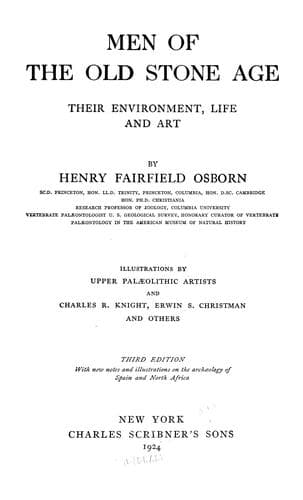
Men of the Old Stone Age: Their Environment, Life and ArtOsborn, Henry Fairfield
History
Men of the Old Stone Age: Their Environment, Life and Art
Osborn, Henry Fairfield
Art, Primitive; Prehistoric peoples; Stone age
In May, 1868, the material was first described by Broca,(16) his excellent
account being later reprinted and amplified in the _Reliquiæ Aquitanicæ_
of Lartet and Christy.(17) Broca referred to these skeletons as
incontestable proofs of the contemporaneous existence of man and the
mammoth. The associated mammalian life was that of the reindeer and the
industry is now known to be of the Aurignacian stage. In his classic
original description of this type Broca remarks upon the high stature, the
face very broad in relation to its height, with very long and very narrow
orbits; the large and markedly dolichocephalic skull, with an unusually
large brain capacity, noting that the brain capacity of the Crô-Magnon
woman surpasses that of the average male of to-day; the forehead
correspondingly broad, vertical, convex on the median line; the bones of
the limbs robust, and the shin-bones flattened transversely; altogether a
very high racial type of skeleton belonging to the species _Homo sapiens_.
[Illustration: FIG. 141. Head of the very tall skeleton of Crô-Magnon type
discovered in the _Grotte des Enfants_. After Verneau. One-quarter life
size.]
[Illustration: FIG. 142. Head of the 'Old Man of Crô-Magnon,' rejuvenated
by the restoration of the teeth, showing the method of restoration of the
features adopted in all the models by J. H. McGregor. The diameter of the
head across the cheek-bones is seen to be greater than that across the
cranium. (Compare Figs. 146 and 147, also Pl. VI.)]
Public-domain text, read in full here on John Shaqi.
Reviews
Reviews
No reviews yet
Be the first to share your thoughts on this work.
Elsewhere in the archive
Join the Discussion
Join the discussion
Sign in to leave a comment or review.
Sign InorCreate an account