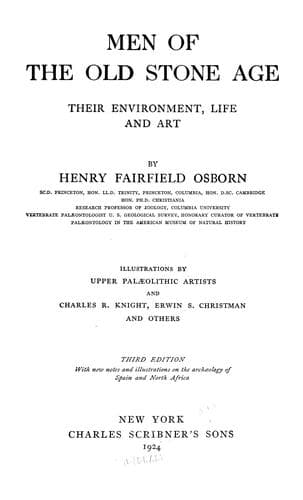
Men of the Old Stone Age: Their Environment, Life and ArtOsborn, Henry Fairfield
History
Men of the Old Stone Age: Their Environment, Life and Art
Osborn, Henry Fairfield
Art, Primitive; Prehistoric peoples; Stone age
The highly evolved characters of the skeleton in this race are in keeping
with the extraordinarily great cranial capacity. Broca estimated the 'old
man of Crô-Magnon' as having a cranial capacity of 1,590 c.cm., and in the
female the brain is estimated at 1550 c.cm. Verneau estimates the five
large male skulls of Crô-Magnon type at Grimaldi as having an average
capacity of 1,800 c.cm., the lowest being 1,715 c.cm., and the highest
1,880 c.cm. This race, observes Keith,(21) was one of the finest the world
has ever seen. The wide, short face, the extremely prominent cheek-bones,
the spread of the palate and a tendency of the upper cutting teeth and
incisors to project forward, and the narrow, pointed chin recall a facial
type which is best seen to-day in tribes living in Asia to the north and
to the south of the Himalayas. As regards their stature the Crô-Magnon
race recalls the Sikhs living to the south of the Himalayas. In the
disharmonic proportions of the face, that is, the combination of broad
cheek-bones and narrow skull, they resemble the Eskimo. The sum of the
Crô-Magnon characters is certainly Asiatic rather than African, whereas in
the Grimaldis the sum of the characters is decidedly negroid or African.
[Illustration: FIG. 146. Restoration of the head of the 'Old Man of
Crô-Magnon,' in profile, modelled after the type skull of Crô-Magnon,
Dordogne, with the teeth restored and the head given a younger appearance.
After the model by J. H. McGregor. One-quarter life size.]
We shall trace this great race through the Solutrean and Magdalenian
stages of the Upper Palæolithic and consider its disappearance and
possible distribution at the close of Magdalenian times. It will then be
interesting to consider the evidence of the survival of the descendants of
this race in various parts of western Europe and possibly among the
primitive inhabitants of the Canary Islands, known as the Guanches.
[Illustration: FIG. 147. Restoration of the head of the 'Old Man of
Crô-Magnon,' front view. After the model by J. H. McGregor. One-quarter
life size.]
EVIDENCE OF OTHER RACES
It is a mooted question whether the Crô-Magnons were the only people
inhabiting Europe in early Aurignacian time or whether there were also two
other races, the _Grimaldi_ and the _Aurignacian_. As we have seen in the
preceding pages, there is no evidence that the negroid Grimaldi race ever
became established in Europe; the idea of the presence of a negroid race
has taken the fancy of archæologists like Breuil and Rutot, when seeking
an African, Egyptian, or Bushman analogy in certain phases of early
Aurignacian art; but it rests merely on the slender evidence afforded by
the isolated skeletons of a woman and of a boy.
Public-domain text, read in full here on John Shaqi.
Reviews
Reviews
No reviews yet
Be the first to share your thoughts on this work.
Elsewhere in the archive
Join the Discussion
Join the discussion
Sign in to leave a comment or review.
Sign InorCreate an account