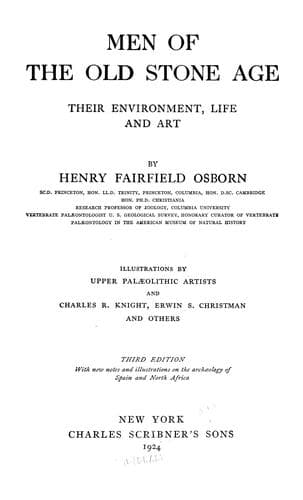
Men of the Old Stone Age: Their Environment, Life and ArtOsborn, Henry Fairfield
History
Men of the Old Stone Age: Their Environment, Life and Art
Osborn, Henry Fairfield
Art, Primitive; Prehistoric peoples; Stone age
The climate of Solutrean times is generally believed to have been cold and
dry. In the region of Dordogne throughout this period the reindeer was
still far more numerous than any other animal; so we may safely conclude
that this was the principal object of the chase and of food; in fact, it
would appear that the reindeer were resident forms in the valley of the
Vézère, hunted and consumed throughout the year.(40) Here we also
occasionally find the northern steppe or Obi lemming, an animal which at
the same time extends along the borders of the Volga River toward southern
Russia. It would appear that in Solutrean times in southwestern France
there prevailed a dry, cold continental subarctic climate like that of the
Caspian, Volga, and Ural steppes of the present day. With the mammoth and
the reindeer occur a great variety of northern European forest forms--the
true fox, the hare, the stag, the brown bear, the wolf, the bison, and the
urus. Most interesting is the identification of the jackal belonging to
the ancient species _C. neschersensis_. In the type industrial locality of
Solutré the reindeer is very abundant in the fire-hearths associated with
the lower Solutrean industry, but less abundant in the upper levels; an
antelope, perhaps the saiga antelope, is said to be found among the crude
engravings on bone.
SOLUTREAN RACES
There were certainly two distinct races of men in Europe during Solutrean
times, to the east the race of Brünn and to the west the race of
Crô-Magnon. Remains attributed to the Crô-Magnons have been found in the
Departments of Charente, Gironde, Lot, Haute-Garonne, Tarn, and Dordogne.
But most of these remains are very fragmentary and cannot readily be
determined racially. The fragments of ten skulls and a few other bones
found in the Grotte du Placard, Charente, are attributed to late Solutrean
and to early Magdalenian times and constitute one of the most exceptional
discoveries which have thus far been made in France; the interments
probably date from the early Magdalenian (p. 380), but are probably of a
race surviving from the Solutrean. The section of the cave deposit is from
23 to 26 feet in thickness and is highly instructive; it shows eight
cultural layers, separated by layers of débris and succeeding each other
in the following order:
8. Neolithic layer.
7-4. Magdalenian layers; in the lowest layer is the ceremonial burial
of four skulls.
3. Solutrean layer with shouldered points (_pointes à cran_) and a few
laurel-leaf points (_pointes de laurier_).
2. Solutrean layer with laurel-leaf points but no shouldered points;
knives, grattoirs, scrapers, borers, in great numbers, together with
javelin points and awls in bone and ornamented with notches, and
fragments of red chalk and black lead found embedded with the
Solutrean points.
1. Mousterian layer.
RACE OF BRÜNN, BRÜX, PŘEDMOST, AND (?) GALLEY HILL
Public-domain text, read in full here on John Shaqi.
Reviews
Reviews
No reviews yet
Be the first to share your thoughts on this work.
Elsewhere in the archive
Join the Discussion
Join the discussion
Sign in to leave a comment or review.
Sign InorCreate an account