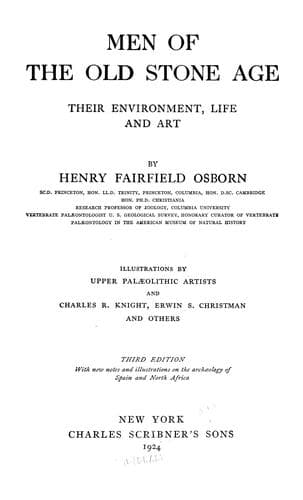
Men of the Old Stone Age: Their Environment, Life and ArtOsborn, Henry Fairfield
History
Men of the Old Stone Age: Their Environment, Life and Art
Osborn, Henry Fairfield
Art, Primitive; Prehistoric peoples; Stone age
The successive phases of Solutrean industry are all shown in southern
France. As to its stratigraphic relations, the type station of Solutré
exhibits lower and middle Solutrean above Aurignacian hearths and
deposits; that of Placard, Charente, shows the middle and upper Solutrean
overlaid by a Magdalenian layer. In the Grotte du Trilobite the Solutrean
layer lies between one of Aurignacian and one of primitive Magdalenian; it
is here that we find the clearest transition from the Aurignacian culture
in the appearance of prototypes of the laurel and willow-leaf points, made
of flakes, retouched on only one side. At Brassempouy the Solutrean lies
immediately beneath a Magdalenian layer, with engraved bones and
Magdalenian flints. Needles, which are particularly abundant in the
Magdalenian epoch, are also found in a number of the Solutrean stations.
In the grotto of Lacave, Lot, in an upper Solutrean layer, Viré has found
beautiful bone needles, pierced at one end and of fine workmanship, and
engraved utensils of reindeer horn; here also was found the head of an
antelope engraved on a fragment of reindeer horn. The local fauna of this
period included the horse, the ibex, and the reindeer.
SOLUTREAN ENGRAVING AND ANIMAL SCULPTURE
The artistic work of Solutrean times is not so rich as that of the
Aurignacian. This, as we have suggested, may be partly attributable to the
less wide-spread distribution of the Solutrean culture, as well as to the
great importance which was attached to the careful fashioning of the stone
weapons. None the less we can trace indications of the development of both
phases of art, the linear and the plastic, and especially the beginnings
of animal sculpture. From the full, round sculpture of Aurignacian times
there follows in Solutrean times a development of carving in bone of the
_Rundstabfiguren_ (bâton, or ceremonial staff), and of high relief. The
lion(57) and the head of a horse at Isturitz, in the Pyrenees, which
Breuil attributes to a late Solutrean period, are typical examples of this
work.
Relatively rare are the parietal and mobile engravings as well as the
schematic representations, such as are found at Placard and Champs Blancs.
According to Alcalde del Rio, there are found at Altamira, in northern
Spain, very simple, finely engraved figures of the doe on the bone of the
shoulder-blade; the head and neck are covered with lines, and both the eye
and the nostril as well as the form of the ear are very characteristic of
the animal. Breuil, however, considers these as belonging rather to
earlier Magdalenian times.
Decorative art certainly makes some advances over the Aurignacian work,
because the arrangement of the geometric figures is quite clear, and the
execution shows marked progress in the technique of engraving.
Public-domain text, read in full here on John Shaqi.
Reviews
Reviews
No reviews yet
Be the first to share your thoughts on this work.
Elsewhere in the archive
Join the Discussion
Join the discussion
Sign in to leave a comment or review.
Sign InorCreate an account