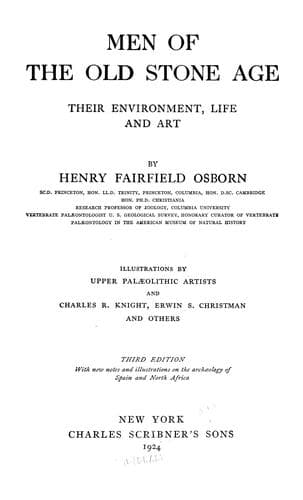
Men of the Old Stone Age: Their Environment, Life and ArtOsborn, Henry Fairfield
History
Men of the Old Stone Age: Their Environment, Life and Art
Osborn, Henry Fairfield
Art, Primitive; Prehistoric peoples; Stone age
In connection with art, the majestic form of the bison seemed to strike
the fancy of the artist more than the less-imposing outlines of the wild
cattle; there are perhaps fifty drawings of the bison to one of the _Bos_.
Among the forest and meadow life, not recognized in the fossil remains,
but clearly distinguished in the work of the artists, are two types of
horses, the forest or Nordic horse, related to the northern or draught
horse, and the diminutive plateau or desert horse (_E. caballus celticus_)
related to the Arab. With the forest life should also be numbered the cave
bear (_Ursus spelæus_) of southwestern Europe and the moose (_Alces_),
indicated by the artists of Aurignacian times as present in the Cantabrian
Pyrenees.
[Illustration: FIG. 184. Heads of four chamois engraved on a fragment of
reindeer horn, from the grotto of Gourdan, Haute-Garonne. After Piette.]
It is the above entire Eurasiatic forest and meadow fauna which survived
all the climatic vicissitudes of Pleistocene time, and which alone
remained in western Europe to the very close of the Upper Palæolithic
culture, and into the period of the arrival of the Neolithic race.
The descent of the European and Asiatic alpine types of mammals to the
lower hills and valleys is one of the most striking episodes of
Magdalenian times. The argali sheep (_Ovis argaloides_) of western Asia
had already appeared in the upper Danubian region during the Aurignacian;
it is replaced in Magdalenian times by the ibex (_Ibex priscus_), and by
the chamois, which descended along the northern slopes of the Alps and of
the Pyrenees, and became numbered among the most highly favored subjects
of the Magdalenian artists, especially in the mobile art of ivory and
bone, and in the decoration of their spear throwers and _bâtons de
commandement_. From the mountains also come the pikas or tailless hares
(_Lagomys pusillus_), the alpine marmot (_Arctomys marmotta_), the alpine
vole (_Arvicola nivalis_), and the alpine ptarmigan (_Lagopus alpinus_).
THE TUNDRA CLIMATE OF EARLY MAGDALENIAN TIMES
Public-domain text, read in full here on John Shaqi.
Reviews
Reviews
No reviews yet
Be the first to share your thoughts on this work.
Elsewhere in the archive
Join the Discussion
Join the discussion
Sign in to leave a comment or review.
Sign InorCreate an account