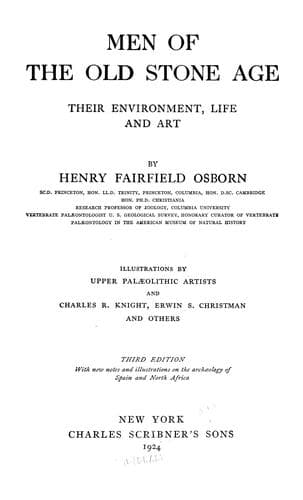
Men of the Old Stone Age: Their Environment, Life and ArtOsborn, Henry Fairfield
History
Men of the Old Stone Age: Their Environment, Life and Art
Osborn, Henry Fairfield
Art, Primitive; Prehistoric peoples; Stone age
This was the culminating point both in Magdalenian industry and art, and
probably also in the morale and modes of living. Characteristic types of
this late Magdalenian culture are found at La Madeleine, Les Eyzies, and
Teyjat, and extend into the northern Pyrenees, at Lourdes, Gourdan, and
Mas d'Azil. Their easterly geographical distribution will be described on
a later page. The microlithic flints now reach their culminating point; to
the small bladed flakes with blunted backs are added little feather-shaped
flint blades, and still others with oblique ends, which begin to suggest
the geometric forms of the succeeding Tardenoisian industry. Among the
flint borers we notice a prevalent type with a stout central point, also
the so-called 'parrot-beak' borer; for the preparation of skins, scrapers
are made, as before, of thin flakes, slightly retouched at both ends to
give a rounded or rectangular form.
Following the late or high Magdalenian stage is a period of decline in
industry. In southern France(18) both flint and bone implements show
unmistakable indications of the approach either of the succeeding
Tardenoisian or Azilian stage. In the Pyrenees both the flints and the
great polishers of deer-horn begin to resemble those which occur in the
post-Magdalenian levels. This industrial stage corresponds broadly with
the period of decline in art, and with the change both in the industrial
habits and in the artistic spirit of the Crô-Magnons.
The divisions of the Magdalenian are, therefore, as follows:
5. Decline of the Magdalenian art and industry.
4. Late Magdalenian typified at La Madeleine, Dordogne.
3. Middle Magdalenian typified at La Madeleine, Dordogne.
2. Early Magdalenian typified at La Madeleine, Dordogne.
1. Proto-Magdalenian typified at Placard, Charente.
FLINT AND BONE INDUSTRY
Through the four successive stages of development which we have already
traced (p. 382) there are perceived certain general tendencies and
characteristics which clearly separate the Magdalenian from the preceding
Solutrean culture.
Public-domain text, read in full here on John Shaqi.
Reviews
Reviews
No reviews yet
Be the first to share your thoughts on this work.
Elsewhere in the archive
Join the Discussion
Join the discussion
Sign in to leave a comment or review.
Sign InorCreate an account