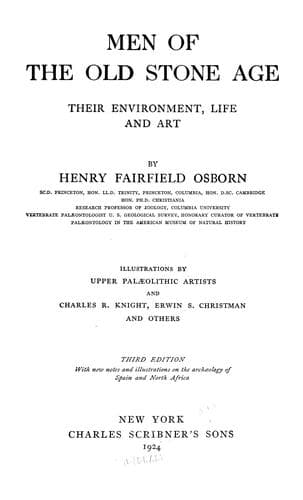
Men of the Old Stone Age: Their Environment, Life and ArtOsborn, Henry Fairfield
History
Men of the Old Stone Age: Their Environment, Life and Art
Osborn, Henry Fairfield
Art, Primitive; Prehistoric peoples; Stone age
Of all the Magdalenian weapons the most characteristic is the harpoon, the
chief fishing implement, which now appears for the first time marked by
the invention of the _barb_ or point retroverted in such a manner as to
hold its place in the flesh. The barb does not suddenly appear like an
inventive mutation, but it very slowly evolves as its usefulness is
demonstrated in practice. The shaft is very rarely perforated at the base
for the attachment of a line; it is cylindrical in form, adapted to the
capture of the large fish of the streams. That a barbed weapon was also
used in the chase seems to be indicated by drawings in the grotto of Niaux
and lines engraved on the teeth of the bear, but these drawings indicate
the form of an arrow rather than of a harpoon. The length varies from two
to fifteen inches. The harpoons may have been projected by means of the
so-called _propulseurs_ or dart-throwers, which resemble implements so
employed by the Eskimo and Australians of to-day. These dart-throwers are
often beautifully carved, as in the case of one found at Mas d'Azil,
ornamented with a fine relief of the ibex.
[Illustration: FIG. 195. Bone needles from the grotto of Lacave, Lot.
After Viré.]
Then there were _bâtons de commandement_, carved with scenes of the chase
and with spirited heads of the horse and other animals, which quite
probably were insignia of office. Reinach has suggested that bâtons were
trophies of the chase, and according to Schoetensack they may have been
used as ornaments to fasten the clothing. The discovery of mural painting
and engraving suggests the possibility that these bâtons were believed to
have some magical influence, and were connected with mysterious rites in
the caverns, for a great variety of such ceremonial staffs is found among
primitive peoples. Geographically, the bâtons spread from the Pyrenees
into Belgium and eastward into Moravia and Russia.
Slender bone needles brought to a fine point on stone polishers indicate
great care in the preparation of clothing. Associated with the borers are
many other bone implements: awls, hammers, chisels, stilettos, pins with
and without a head, spatulas, and polishers; the latter may have been
employed in the preparation of leather. The borers, pins, and polishers
appear from the very beginning of the period of sculpture. The name of
poniard (_poignard_) is given to long points of reindeer-horn; one of
these was found at Laugerie Basse.
HISTORY OF UPPER PALÆOLITHIC ART
Public-domain text, read in full here on John Shaqi.
Reviews
Reviews
No reviews yet
Be the first to share your thoughts on this work.
Elsewhere in the archive
Join the Discussion
Join the discussion
Sign in to leave a comment or review.
Sign InorCreate an account