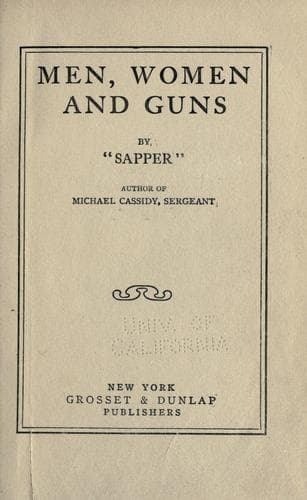
War stories, English; World War, 1914-1918 -- Fiction
No longer did the men who waited to be fetched excuse him--even though
he had "done his bit." No longer was it possible to shelter behind
another man's failure, and plead for so-called equality of sacrifice. To
him had come the meaning of tradition--that strange, nameless something
which has kept regiments in a position, battered with shells, stunned
with shock, gassed, brain reeling, mind gone, with nothing to hold them
except that nameless something which says to them, "Hold on!" While
other regiments, composed of men as brave, have not held. To him had
come that quality which has sent men laughing and talking without a
quaver to their death; that quality which causes men--eaten with fever,
lonely, weary to death, thinking themselves forsaken even of God--to
carry on the Empire's work in the uttermost corners of the globe, simply
because it is their job.
He had assimilated to a certain extent the ideas of that stern, dead
soldier; he had visualised them; he had realised that the destinies of a
country are not entrusted to all her children. Many are not worthy to
handle them, which makes the glory for the few all the greater....
Winds of the world, give answer! They are whimpering
to and fro--
And what should they know of England, who only
England know?
The poor little street-bred people that vapour and fume
and brag,
They are lifting their heads in the stillness to yelp at
the English Flag.
* * * * *
Never the lotos closes, never the wild-fowl wake,
But a soul goes out on the East wind that died for
England's sake--
Man or woman or suckling, mother or bride or maid--
Because on the bones of the English the English flag is
stayed.
CHAPTER IV
"THE REGIMENT"
On the Tuesday a board of doctors passed Jim Denver fit for General
Service, having first given him the option of a month's home service if
he liked. Two days after he turned up at the depot of his regiment,
where he found men in various stages of convalescence--light duty,
ordinary duty at home, and fit to go out like himself. One or two he
knew, and most of them he didn't. There were a few old regular officers
and a large number of very new ones--who were being led in the way they
should go.
But there is little to tell of the time he spent waiting to go out. This
is not a diary of his life--not even an account of it; it is merely an
attempt to portray a state of mind--an outlook on life engendered by
war, in a man whom war had caused to think for the first time.
Public-domain text, read in full here on John Shaqi.
Reviews
Reviews
No reviews yet
Be the first to share your thoughts on this work.
Elsewhere in the archive
Join the Discussion
Join the discussion
Sign in to leave a comment or review.
Sign InorCreate an account