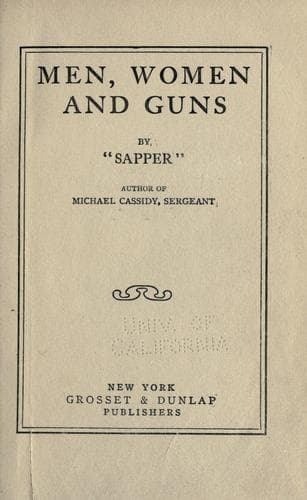
War stories, English; World War, 1914-1918 -- Fiction
"Non-commissioned officers and men"--his voice carried to every corner
of the building--"I think you will all agree with me that we are very
pleased to see Colonel Johnson and all our officers here with us
to-night. It is our farewell concert in England: in a few days we shall
all be going--somewhere; and it gives us all great pleasure to welcome
the officers who are going to lead us when we get to that somewhere.
Therefore I ask you all to fill up your glasses and drink to the health
of Colonel Johnson and all our officers."
A shuffling of feet; an abortive attempt on the part of the pianist to
strike up "For he's a jolly good fellow" before his cue, an attempt
which died horribly in its infancy under the baleful eye of the
sergeant-major; a general creaking and grunting and then--muttered,
shouted, whispered from a thousand throats--"Our Officers." The pianist
started--right this time--and in a second the room was ringing with the
well-known words. Cheers, thunderous cheers succeeded it, and through it
all the officers sat silent and quiet. Most were new to the game; to
them it was just an interesting evening; a few were old at it; a few,
like Jim, had been across, and it was they who had a slight lump in
their throats. It brought back memories--memories of other men, memories
of similar scenes....
At last the cheering died away, only to burst out again with renewed
vigour. The colonel was standing up, a slight smile playing round his
lips, the glint of many things in his quiet grey eyes. To the second in
command, a sterling soldier but one of little imagination, there came
for the first time in his life the meaning of the phrase, "the windows
of the soul." For in the eyes of the man who stood beside him he saw
those things of which no man speaks; the things which words may kill.
He saw understanding, affection, humour, pain; he saw the pride of
possession struggling with the sorrow of future loss; he saw the desire
to test his creation struggling with the fear that a first test always
brings; he saw visions of glorious possibilities, and for a fleeting
instant he saw the dreadful abyss of a hideous failure. Aye, for a few
moments the second in command looked not through a glass darkly, but saw
into the unplumbed depths of a man who had been weighed in the balance
and not found wanting; a man who had faced responsibility and would face
it again; a man of honour, a man of humour, a man who knew.
Public-domain text, read in full here on John Shaqi.
Reviews
Reviews
No reviews yet
Be the first to share your thoughts on this work.
Elsewhere in the archive
Join the Discussion
Join the discussion
Sign in to leave a comment or review.
Sign InorCreate an account