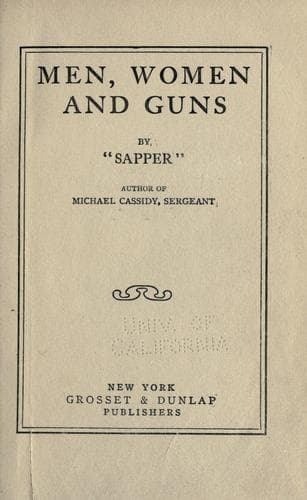
War stories, English; World War, 1914-1918 -- Fiction
And then we fell silent, as men will at such a time. The trench outside
was quiet; the musician, having obliged with his encore, no longer
rendered the night hideous--even the guns were still. What would it be
to-morrow night? Should I still be...? I shook myself and started to
scribble a letter; I was getting afraid of inactivity--afraid of my
thoughts.
"I'm going along the trenches," said Hugh suddenly, breaking the long
silence. "I want to see the Sergeant-Major and give some orders."
He was gone, and I was alone. In spite of myself my thoughts would drift
back to what he had been saying, and from there to his wife and the son
and heir. My mind, overwrought, seemed crowded with pictures: they
jumbled through my brains like a film on a cinematograph.
I saw his marriage, the bridal arch of officers' swords, the
sweet-faced, radiant girl. And then his house came on to the screen--the
house where I had spent many a pleasant week-end while we trained and
sweated to learn the job in England. He was a man of some wealth was
Hugh Latimer, and his house showed it; showed moreover his perfect,
unerring taste. Bits of stuff, curios, knick-knacks from all over the
world met one in odd corners; prints, books, all of the very best,
seemed to fit into the scheme as if they'd grown there. Never did a
single thing seem to whisper as you passed, "I'm really very rare and
beautiful, but I've been dragged into the wrong place, and now I know
I'm merely vulgar." There are houses I wot of where those clamorous
whispers drown the nightingales. But if you can pass through rooms full
of bric-a-brac--silent bric-a-brac: bric-a-brac conscious of its
rectitude and needing no self apology, you may be certain that the owner
will not give you port that is improved by a cigarette.
Then came the son, and Hugh's joy was complete. A bit of a dreamer, a
bit of a poet, a bit of a philosopher, but with a virility all his own;
a big man--a man in a thousand, a man I was proud to call Friend. And
he--at the dictates of "Kultur"--was to-morrow at 6.35 going to expose
himself to the risk of death, in order to wrest from the Hun a small
portion of unprepossessing ground. Truly, humour is not dead in the
world!...
A step outside broke the reel of pictures, and the Sapper Officer looked
in. "I hear a whisper of activity in the dark and stilly morn," he
remarked brightly. "Won't it be nice?"
"Very," I said sarcastically. "Are you coming?"
"No, dear one. That's why I thought it would be so nice. My opposite
number and tireless companion and helper to-morrow morning will prance
over the greensward with you, leading his merry crowd of minions,
bristling with bowie knives, sandbags, and other impedimenta."
"Oh! go to Hell," I said crossly. "I want to write a letter."
Public-domain text, read in full here on John Shaqi.
Reviews
Reviews
No reviews yet
Be the first to share your thoughts on this work.
Elsewhere in the archive
Join the Discussion
Join the discussion
Sign in to leave a comment or review.
Sign InorCreate an account