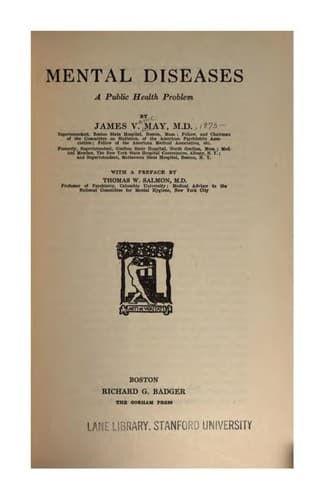
Mental diseases: a public health problemMay, James Vance
Science
Mental diseases: a public health problem
May, James Vance
Mental health services; Psychology, Pathological
If we speak of predisposing causes, some reference should be made
to the influence of the physiological landmarks which are of so
much significance in the life of the individual in more ways than
one—puberty, adolescence, the climacterium and the senium. A no
less noteworthy factor in the female sex is the puerperium. These
periods of life are of tremendous importance in the development of
the psychoses. It is customary to speak of age, sex, race, civil
condition, degree of education, climate, civilization, etc., as factors
in the production of mental diseases. Not much is to be said on these
questions, nor are they closely related to the subject. On January
1, 1920, there were 232,680 patients in the hospitals for mental
diseases in the United States. Fifty-two per cent of these were men and
forty-eight per cent women. This represents about the difference that
has been shown for many years. The reduction in alcoholic psychoses
may affect this ultimately. The striking exceptions to this ratio are
Massachusetts and New York, where the number of women has slightly
exceeded the men for a number of years. The admission rate for men
is, however, slightly higher than that for women in both of those
states. Less than one-half of one per cent of the patients admitted to
the New York hospitals are under fifteen years of age. In that state
approximately five per cent have been between fifteen and nineteen
years old. In Massachusetts the percentage of persons admitted who
were under twenty years of age has averaged 8.5 quite consistently for
some time. The admission rate, for twenty to twenty-five, twenty-five
to thirty, thirty to thirty-five and thirty-five to forty years of age
in Massachusetts and New York has averaged from ten to eleven per cent
for each of those periods for several years. From the age of forty
to fifty the admission rate is about 8.5 per cent, and from fifty to
sixty between five and six per cent. Nine per cent of the admissions in
Massachusetts and eight per cent in New York are seventy years of age
or over. The statistics on race, birthplace and the psychoses of the
various races are shown in detail in the chapter on Immigration. The
admission rate in New York is almost exactly the same for the married
and the unmarried, the former constituting about thirty-nine per cent
and the latter forty. In Massachusetts the single first admissions
amount to about forty-three per cent and the married approximately
forty per cent. Throughout the country generally the unmarried slightly
predominate. The percentage of widowed in Massachusetts and New York
varies from thirteen to fourteen per cent. The divorced constitute
only about one per cent of all admissions. As to education, it may be
said that about nine per cent of all first admissions are illiterate,
from fifteen to twenty per cent can read and write only, about sixty
per cent have had a high school and two per cent a college education.
Public-domain text, read in full here on John Shaqi.
Reviews
Reviews
No reviews yet
Be the first to share your thoughts on this work.
Elsewhere in the archive
Join the Discussion
Join the discussion
Sign in to leave a comment or review.
Sign InorCreate an account