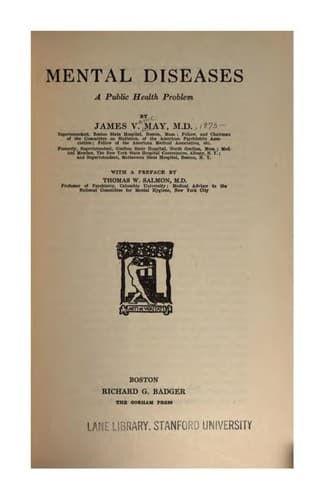
Mental diseases: a public health problemMay, James Vance
Science
Mental diseases: a public health problem
May, James Vance
Mental health services; Psychology, Pathological
Numerous court decisions have had a material bearing on the subject of
responsibility. It has been held in New York that partial or incipient
insanity is not a sufficient defense if there is still an ability to
form a correct perception of the legal quality of the act and to know
that it was wrong. (People vs. Taylor, 138 N. Y. 398, 407 (1893)).
A weak or disordered mind is not excused from the consequences of
crime. (People vs. Burgess, 153 N. Y. 561, 569 (1897)), etc. Generally
speaking, the legal methods of determining criminal responsibility
do not vary to any material extent with the different states. It is
obvious that the responsibility for crime as defined by the courts is
far from harmonizing with the conception of competency entertained by
the medical profession. To the psychiatrist, if the criminal act is the
result of the mental condition it constitutes a symptom of the disease
process. It is readily apparent from even a very brief reference to
the statutes that a person concededly suffering from paranoia, general
paresis, dementia praecox or any other well-defined psychosis is still
criminally liable for his insane acts within certain limitations. From
a medical point of view the existence of a psychosis, if associated
with a consequent judgment defect, emotional instability, disturbance
of volition, intellectual deterioration, delusional and particularly
persecutory control, hallucinatory trends, ideas of reference, etc.,
is of itself quite sufficient to explain criminal acts in the insane.
This, however, as has been shown, is not the legal point of view.
The accused is fully responsible unless it can be shown that he is
suffering from such a defect of reason as not to appreciate the quality
or nature of his act or that the act is wrong. There is no other legal
standard. It is a well-known fact that many persons adjudged insane by
the courts and committed to our institutions are fully competent to
discriminate between right and wrong from an ethical point of view,
although legally held to be incompetent and unsafe to be at large.
These divergent viewpoints presumably are due to the fact that the law
moves only with a degree of dignity which theoretically guarantees
absolute security in avoiding any possible sources of error. It
nevertheless is responsible for many miscarriages of justice.
Efforts to remedy this state of affairs have been made repeatedly
by the medical profession. The American Psychiatric Association
has devoted a great deal of time and attention to this subject,
unfortunately without any very concrete results. The last
official action taken was the unanimous approval of the following
resolutions:—[81]
"Resolved: 1. That the proved rarity of wrong acquittals on the ground
of insanity is the strongest evidence that the abuse of the insanity
plea in criminal cases has been unwarrantably exaggerated.
Public-domain text, read in full here on John Shaqi.
Reviews
Reviews
No reviews yet
Be the first to share your thoughts on this work.
Elsewhere in the archive
Join the Discussion
Join the discussion
Sign in to leave a comment or review.
Sign InorCreate an account