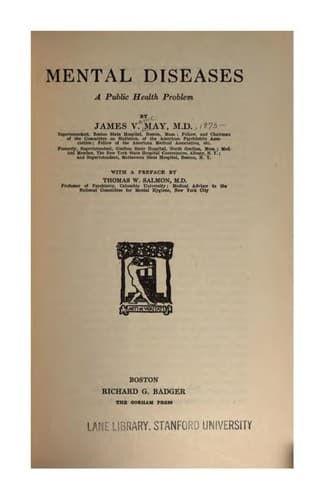
Mental diseases: a public health problemMay, James Vance
Science
Mental diseases: a public health problem
May, James Vance
Mental health services; Psychology, Pathological
The problem presenting itself in the adoption of a classification
purely for statistical purposes was not a question of a scientific
grouping of the psychoses based on either etiological, anatomical,
pathological, clinical or prognostic considerations. It was a question
of compiling a tabulation or list of clinical entities recognized
generally by American psychiatrists, subject to such changes and
modifications as may be necessary to make it conform to accepted
standards. As a matter of fact, no adequate reason for a classification
of mental diseases for any other than statistical purposes has even
been advanced by the authors of our textbooks on psychiatry. They
do not contribute anything of value whatever to our knowledge of
symptomatology, diagnosis or treatment. Practically the only point
on which the writers of our textbooks agree is that there is no one
fundamental principle upon which a satisfactory classification can be
based. It is unfortunate that tradition seems to demand the serious
consideration of a problem which many believe admits of no solution and
which would mean little or nothing to the future of psychiatry if it
were solved. The views of the Committee on Statistics are shown by a
quotation from the report made to the Association at its meeting in
New York in 1917:—"Your Committee feels that the first essential
of a uniform system of statistics in hospitals for the insane is a
generally recognized nomenclature of mental diseases. The present
condition with respect to the classification of mental diseases is
chaotic. Some states use no well-defined classification. In others the
classifications used are similar in many respects but differ enough
to prevent accurate comparisons. Some states have adopted a uniform
system, while others leave the matter entirely to the individual
hospitals. This condition of affairs discredits the science of
psychiatry and reflects unfavorably upon our Association, which should
serve as a correlating and standardizing agency for the whole country.
The large task of your Committee therefore has been the formulation of
a classification which it could unanimously recommend for adoption by
the Association. The task was accomplished only after several prolonged
conferences at which classifications now in use in various states
and countries, and the recommendations of leading psychiatrists were
considered. The classification finally adopted is simple, comprehensive
and complete; it copies no other classification but includes the strong
features of many others; it meets the demands of the best modern
psychiatry but does not slavishly follow any single system. In short,
your Committee has endeavored to formulate a classification that could
be easily used in every hospital for the insane in this country and
that would meet the scientific demands of the present day."
Public-domain text, read in full here on John Shaqi.
Reviews
Reviews
No reviews yet
Be the first to share your thoughts on this work.
Elsewhere in the archive
Join the Discussion
Join the discussion
Sign in to leave a comment or review.
Sign InorCreate an account