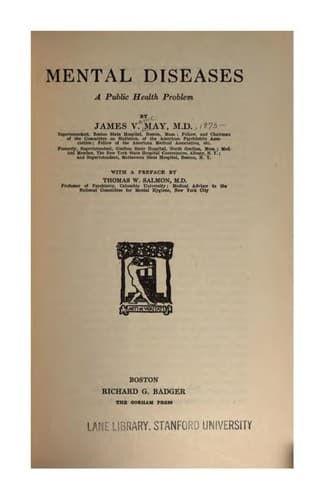
Mental diseases: a public health problemMay, James Vance
Science
Mental diseases: a public health problem
May, James Vance
Mental health services; Psychology, Pathological
A work by Ericksen in 1866 on "Railway Injuries to the Nervous
System" and Page's book in 1882 on "Injuries of the Spine" pointed
the way to an extensive study of the so-called traumatic neuroses.
This characterization of the functional disturbances of the nervous
system following injuries was apparently the result of a monograph by
Oppenheim on that subject in 1889. They had previously been considered
as purely organic in origin. Traumatic hysteria was discussed very
fully at various times by Charcot, whose work is so well known as to
require no comment. In 1892 Friedmann described a vasomotor complex
due to concussion. This is accompanied by such symptoms as headache,
dizziness, loss of capacity for both physical and mental work with
an increased fatigability, irritability, memory defects, and changes
in personality, such as sensitiveness and eccentricity with a marked
intolerance to alcohol. This condition appears some time after the
symptoms of concussion and shock have subsided and may last for some
months. Friedmann looked upon this as purely a vasomotor disturbance.
It is probably an important factor, in some cases at least, of
"shell shock". Traumatic epilepsy may result from foci of softening
or other local areas of injury to the brain. Neurasthenia, hysteria
and other neuroses are now generally looked upon as being essentially
functional and not organic in origin, although they may follow a
trauma. The simulation of these conditions has led to a great deal of
discussion, notwithstanding the fact that Oppenheim found them in only
about four per cent of his cases. Köppen (1897) made a very elaborate
study of the postmortem lesions in the "traumatic neuroses". He found
that violence to the skull often resulted in small injuries at the
base of the frontal area, at the apices of the parietal lobes or in
the occipital region. The pathological changes involved represented
localized encephalitis with hemorrhagic infiltration. Foci of softening
were often found in the cerebral cortex. He noted coma and convulsions
with only minute areas of destruction of the basal cortex at autopsy.
This would indicate a severe irritation, probably due to circulatory
disturbances. The resulting symptoms he thought were very likely to be
confused with general paresis. In cases of extreme dementia following
traumatism he often found no pathological lesion other than a cicatrix
in the cerebral cortex.
Public-domain text, read in full here on John Shaqi.
Reviews
Reviews
No reviews yet
Be the first to share your thoughts on this work.
Elsewhere in the archive
Join the Discussion
Join the discussion
Sign in to leave a comment or review.
Sign InorCreate an account