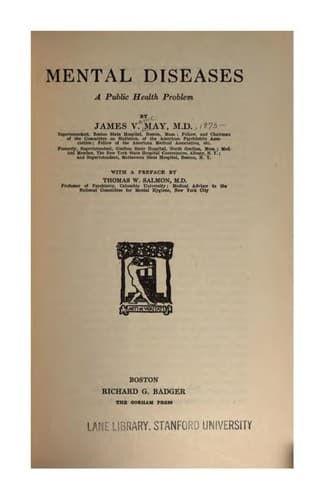
Mental diseases: a public health problemMay, James Vance
Science
Mental diseases: a public health problem
May, James Vance
Mental health services; Psychology, Pathological
The most interesting feature perhaps of this classification is the
post-traumatic constitution. Meyer[153] quotes Köppen's excellent
description of this condition as follows:—"Men who have suffered from
a cranial lesion in which there has been a severe damage of the brain,
with or without an injury to the cranial bones, on their recovery from
the immediate results complain especially of all kinds of sensations
in the head, which they describe either as pain or as pressure with
feeling of crawling or dullness of the head, more or less definitely
located at the point where they were hit. They frequently become
dizzy, and at times even faint for a short time without any epileptic
attack. Although slight attacks of dizziness may recur frequently,
epilepsy with typical attacks need not develop. There is further in our
patients a great irritability and nervosity. The formerly good-natured
or even-tempered persons become irascible, hard to get along with;
formerly conscientious fathers cease to care for their family. The
irritability at times increases to excessive violence in which actions
occur of which they have no remembrance; the nervous system is not only
under the influence of psychic irritation but especially susceptible
to the influence of alcohol or tobacco, in even small quantities. The
working capacity of our patients is very poor. It suffers variously,
although such individuals often give an impression of perfect capacity;
and since the morbid symptoms are essentially subjective, they always
arouse doubts whether they could not do something at least, even if
they are unable to work in a noisy shop or on a high scaffolding. It
is, however, certain that the patients are very forgetful; in giving
orders or doing errands they make the most incredible blunders;
frequently everything must be written down. Their capacity for thought
has suffered, as is sometimes shown, especially in the great slowness
of thought. These patients are unable to concentrate their attention,
not even in occupations which serve for mere entertainment, such as
reading or playing cards. They like best to brood unoccupied; even
conversation is rather obnoxious. This point is so characteristic that
it gives a certain means of distinction from simulation, which as a
rule does not interfere with taking part in the conversations and
pleasures of the ward and playing at cards, which means as a rule too
much of an effort for the brain of actual sufferers. The patients are
usually advised to take light physical work, but even there they are
perfectly useless. Excessive sensitiveness of their head obliges them
to avoid all work which is connected with sudden jerks, bending over is
especially troublesome; and there is hardly any physical work in which
this can be avoided; the blood rushes to the head, headache increases,
dizziness sets in and the work stops. Patients feel best when in the
open air, inactive and undisturbed. There are but few objective signs,
Public-domain text, read in full here on John Shaqi.
Reviews
Reviews
No reviews yet
Be the first to share your thoughts on this work.
Elsewhere in the archive
Join the Discussion
Join the discussion
Sign in to leave a comment or review.
Sign InorCreate an account