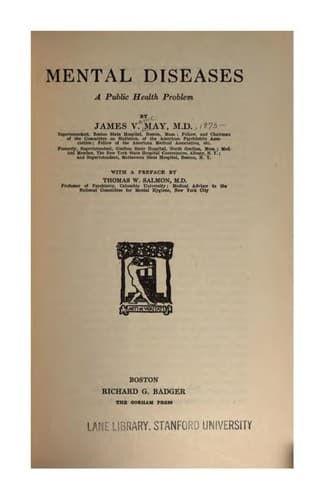
Mental diseases: a public health problemMay, James Vance
Science
Mental diseases: a public health problem
May, James Vance
Mental health services; Psychology, Pathological
Never until very recently has any great importance been attached to the
psychoses due solely to age or much interest manifested in them. These
forms of insanity in the majority of our textbooks have appeared only
under the designation of senile dementia. This is true of the earlier
editions of Krafft-Ebing and many other writers. Clouston referred to
senile dementia as one of four varieties of mental enfeeblement. "Most
cases,"[156] he says, "fall under three varieties. The first has as its
chief characteristics depression and lethargy. The second consists
chiefly of excitement, sometimes with a certain exaltation, but always
with irritability, restlessness, unreason, suspicion, and change of
affection. The third variety consists chiefly of the abolition of
mind in all its forms, or senile dementia, and of complete dotage. In
some cases those three varieties form three different stages in the
same case. In others they do not change." Régis, in a work on mental
medicine covering 668 pages in all, devoted two and one-half pages to
a consideration of the insanity of old age. Ziehen[157] in 1894 included
"dementia senilis" with general paralysis, epileptic, alcoholic and
terminal deteriorations in his group of "acquired defect psychoses" and
characterized it as "a chronic organic psychosis of advanced years,
the principal symptom of which is a progressive intelligence defect."
Excitements, depressions, confusional states, deliria, deteriorations,
mental mechanisms of any and all kinds, occurring late in life,
were usually disposed of without any effort at differentiation by
the very convenient method of relegating them to the obscure domain
of senile dementia. This is a field which on exploration has been
found to be one of considerable interest. It has been pointed out
that manic-depressive insanity not infrequently occurs in persons of
advanced age. Uncomplicated alcoholic psychoses are not at all rare.
Bleuler has advanced the theory that dementia praecox and certain of
the senile conditions are similar if not identical processes. General
paresis has been demonstrated in the later periods of life by modern
laboratory methods and the diagnosis confirmed at autopsy. Cerebral
syphilis certainly cannot be left out of consideration. Toxic deliria
are encountered now and then. Even the psychoneuroses are possibilities.
Public-domain text, read in full here on John Shaqi.
Reviews
Reviews
No reviews yet
Be the first to share your thoughts on this work.
Elsewhere in the archive
Join the Discussion
Join the discussion
Sign in to leave a comment or review.
Sign InorCreate an account