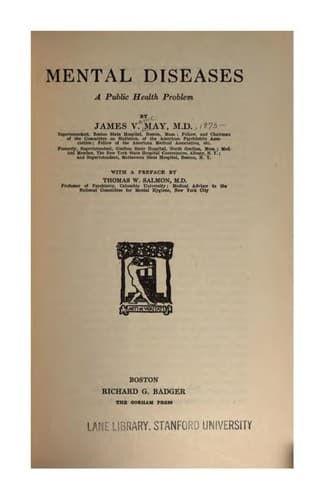
Mental diseases: a public health problemMay, James Vance
Science
Mental diseases: a public health problem
May, James Vance
Mental health services; Psychology, Pathological
The "expansive form," according to Kraepelin, may begin with an
initial depression or show excitement early. Megalomanic symptoms of
the most extravagant variety soon appear. The marked mental weakness
is, however, very manifest. Hallucinations of sight and hearing
are frequently present but transitory. The mood is usually happy,
although hypochondriacal ideas occur for short periods now and then.
Excitability is more common, sometimes with unusual violence. The
course tends to a complete deterioration, with occasional exacerbations
of excitement. Kraepelin found that the expansive form constituted
about thirty per cent of his Heidelberg cases. Convulsions were less
frequent and remissions more common than in other types. He found that
this form of the disease, moreover, occurred later in life. Forty per
cent died within the first two years. Some cases, on the other hand,
were of long duration; one of seven, another of eight, and one of
fourteen years. He also noted mixed varieties with alternations between
excitement and depression.
The "agitated" form as described by Kraepelin is that type in which
extreme excitements predominate. It is often of sudden onset. Grandiose
ideas, even more extravagant than those of the expansive form, appear.
A flight of ideas may be observed at times and stupor often intervenes.
The most severe cases are those which have been referred to by some
writers as "galloping" paresis. An actual delirium may lead to an early
termination in death. The agitated type constituted 6.3 per cent of
Kraepelin's cases. He finds this condition somewhat analogous to the
delirious states due to alcoholism.
Remissions are more common in the agitated and expansive forms of the
disease and may vary in duration from a few months in some instances
to one of fourteen years reported by Dobrschansky. Nissl confirmed
the diagnosis of paresis at autopsy in a case observed by Tuczek
which had been stationary for nearly twenty years. Alzheimer reported
another with a known duration of thirty-two years. Kraepelin has found,
however, that fifty per cent of his paretics die within the first two
years. He reports unequal pupils in from fifty to sixty per cent of
those examined. He also finds that pupillary irregularity is one of the
earliest physical signs in many individuals. Complete loss of light
reaction was found in from fifty to sixty per cent of all cases, with
a reduced range of reaction in from thirty to forty per cent. He found
epileptiform or other attacks present in from thirty to forty per cent
of those studied. Decreased or absent patellar reflexes were noted
about twice as often as were increased reflexes. In from two-thirds
to three-fourths of all cases he found both the posterior column and
lateral tracts of the cord involved.
Public-domain text, read in full here on John Shaqi.
Reviews
Reviews
No reviews yet
Be the first to share your thoughts on this work.
Elsewhere in the archive
Join the Discussion
Join the discussion
Sign in to leave a comment or review.
Sign InorCreate an account