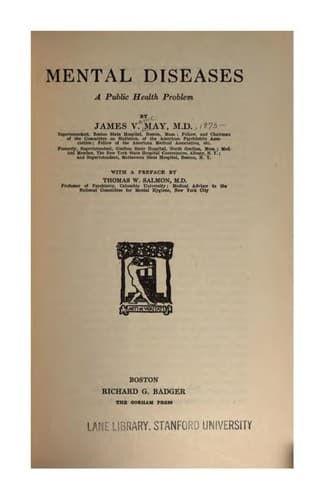
Mental diseases: a public health problemMay, James Vance
Science
Mental diseases: a public health problem
May, James Vance
Mental health services; Psychology, Pathological
Warthin[188] at autopsy found evidences of active syphilis in a series
of forty-one inactive or "cured" cases investigated by him. Eleven of
these had been treated, were supposed to have recovered and showed
no syphilitic manifestations at the time of death. Five had received
an extended course of salvarsan therapy and in twenty-five there
was no history of syphilis at all. Spirochaetes were demonstrated
by the Levaditi method in thirty-six of the forty-one cases—in the
aorta in thirty-two, in the testes in thirty-one, in the liver in
four, in the adrenals in six, in the pancreas in six, in the spleen
in one and in the nervous system in five. In some of these cases the
Wassermann reaction was reported as negative. Warthin concluded that
cured syphilis in many if not all instances is in a latent condition,
spirochaetes of a low virulence still remaining active.
For purposes of statistical study the American Psychiatric Association
has not attempted any clinical differentiation of the various types
of this disease, a procedure which was felt to be inadvisable at
this time. The following suggestions appear in the manual as to the
classification of psychoses due to cerebral syphilis:—
"Since general paralysis itself is now known to be a parenchymatous
form of brain syphilis, the differentiation of the cerebral
syphilis cases might on theoretical grounds be regarded as less
important than formerly. Practically, however, the separation of the
non-parenchymatous forms is very important because the symptoms, the
course and therapeutic outlook in most of these cases are different
from those of general paralysis.
"According to the predominant pathological characteristics, three types
of cerebral syphilis may be distinguished, viz.: (a) Meningitic, (b)
Endarteritic, and (c) Gummatous. The lines of demarcation between
these types are not, however, sharp ones. We practically always find in
the endarteritic and gummatous types a certain amount of meningitis.
"The acute meningitic form is the most frequent type of cerebral
syphilis and gives little trouble in diagnosis; many of these cases
do not reach state hospitals. In most cases after prodromal symptoms
(headache, dizziness, etc.) there is a rapid development of physical
signs, usually cranial nerve involvement, and a mental picture of
dulness or confusion with few psychotic symptoms except those related
to a delirious or organic reaction.
"In the rarer chronic meningitic forms which are apt to occur a long
time after the syphilitic infection, usually in the period in which
we might expect general paralysis, the diagnostic difficulties may be
considerable.
"In the endarteritic forms the most characteristic symptoms are those
resulting from focal vascular lesions.
"In the gummatous forms the slowly developing focal and pressure
symptoms are most significant.
Public-domain text, read in full here on John Shaqi.
Reviews
Reviews
No reviews yet
Be the first to share your thoughts on this work.
Elsewhere in the archive
Join the Discussion
Join the discussion
Sign in to leave a comment or review.
Sign InorCreate an account