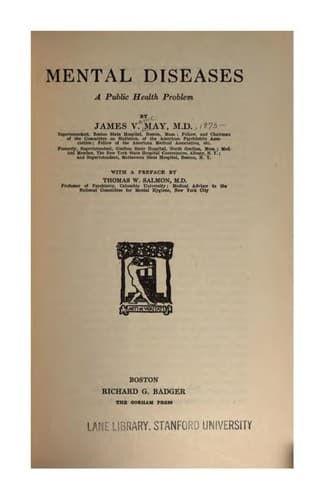
Mental diseases: a public health problemMay, James Vance
Science
Mental diseases: a public health problem
May, James Vance
Mental health services; Psychology, Pathological
The literature of medicine contains many references to acute chorea. It
was referred to, according to Paton, by Plat as early as 1614 and was
discussed by Sydenham at some length. Wharton Sinkler, in describing
chorea in Pepper's "System of Medicine" in 1886, made the following
interesting remarks on the mental changes involved:—"The child is
irritable and feverish, cries and laughs readily, or is sullen and
morose. Sometimes he is violent to those about him but this is rare.
Intellectually the patient suffers somewhat. He is not able to study
as before, and the memory may be impaired. Sometimes there is a mild
form of dementia." Burr[206] divides these conditions into four
groups:—"First (and this includes the vast majority), patients in
whom there is peevishness, fretfulness, some loss of the power of
fixing the attention, and a slight loss of the moral sense shown by
disobedience and selfishness. Second, those showing in addition to
the above symptoms, night terrors, and transitory, visual, auditory,
or other hallucinations. Third, those with distinct delirium, wild
or mild, accompanied with fever. Fourth (and this group is very
small when we remember how common chorea is), those showing stupor,
or rather stupidity, and an acute dementia, which may follow the
condition described under three, or appear without any preceding
mental symptoms at all severe, and which is usually accompanied with
trouble on articulation not caused by choreic movements of the lips
and tongue, but the result of mental hebetude." White[207] refers to
the irritability and emotional instability of choreics and describes a
psychosis in "chorea insaniens" characterized by an acute confusion,
sometimes of a violent type with hallucinations, or a paranoic
condition with delusions of persecution. This may develop into a
stuporous state. Kraepelin describes the psychotic manifestations of
acute chorea as forms of delirium due to infection with characteristic
states of clouding, confusion, etc. Wechsler has expressed similar
views.
Public-domain text, read in full here on John Shaqi.
Reviews
Reviews
No reviews yet
Be the first to share your thoughts on this work.
Elsewhere in the archive
Join the Discussion
Join the discussion
Sign in to leave a comment or review.
Sign InorCreate an account