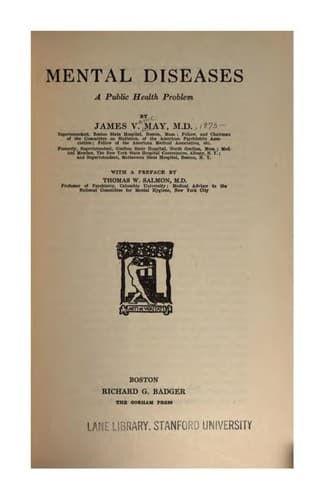
Mental diseases: a public health problemMay, James Vance
Science
Mental diseases: a public health problem
May, James Vance
Mental health services; Psychology, Pathological
Notwithstanding the extended discussion and scientific research of the
last few years, the question as to the definite etiology of pellagra
has not as yet been positively settled. The maize or Indian corn theory
was first advocated by Mazari in 1810. He believed the symptoms to be
due to a deficiency in gluten. Sette in 1826 attributed the disease to
a fungus (scimelpige) growing on corn and producing a poison from the
oil in the grain. The smut of corn, "Ustilago Maydis," was suggested
as a possible factor by Pari in 1860. In 1872 Lombroso formulated his
toxic theory: "In pellagra we are dealing with an intoxication produced
by poisons developed in spoiled corn through the action of certain
microorganisms, in themselves harmless to man." He also announced the
discovery of "pellagrosein," a toxic substance extracted from spoiled
corn. In 1902 Ceni advanced the theory that the disease was caused
by the action of certain moulds such as the aspergillus fumigatus
and flavescens. The Illinois Pellagra Commission in 1911 came to the
conclusion after an elaborate investigation of the subject that the
primary etiological factor involved was a living microorganism of
unknown nature, that the probable source of infection was through the
intestinal tract and that a deficient amount of animal protein in the
diet probably acted as a predisposing cause. Funk in 1914 suggested
a vitamin deficiency in the diet brought about by the consumption of
overmilled corn. Voegtlin[245] in the same year expressed the opinion
that the disease was essentially a chronic intoxication,—"While the
agents at work in this intoxication are as yet unknown, I am inclined
to believe that toxic substances exist in certain vegetable foods, not
necessarily spoiled, which, if consumed by man over a long period of
time, may produce an injurious effect on certain organs of the body....
It is probably more than a mere coincidence that the population of
that part of the world in which pellagra is endemic lives on a mainly
vegetable diet."
In 1916 a study was made by Koch and Voegtlin[246] of the chemical
changes found in the nervous system in pellagra which was very
significant in its results. They found an increase in water with a
decrease in proteins and lipoids, the latter reaction being attributed
to a degeneration in the white matter. There was also a relative
increase in the cholesterol content, looked upon as a compensatory
protective function tending to replace the loss in lipoids. The most
marked chemical alterations were found in the cord. On feeding monkeys
and rats with an exclusive vegetable diet, changes in the chemical
reaction of the brain and cord of almost exactly the same type were
brought about experimentally.
Public-domain text, read in full here on John Shaqi.
Reviews
Reviews
No reviews yet
Be the first to share your thoughts on this work.
Elsewhere in the archive
Join the Discussion
Join the discussion
Sign in to leave a comment or review.
Sign InorCreate an account