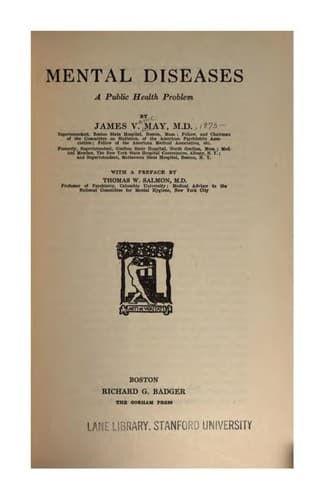
Mental diseases: a public health problemMay, James Vance
Science
Mental diseases: a public health problem
May, James Vance
Mental health services; Psychology, Pathological
He found mental disturbances of some kind in about forty per cent of
the cases examined. As a general rule they appeared after the patient
had shown evidence of several attacks of the disease. The psychoses
occurred in men between the ages of twenty-one and forty and in women
between forty-one and sixty. About ninety-five per cent of the mental
disorders were to be attributed directly to the effect of the toxin.
The remaining five per cent represented individuals with a defective
nervous organization or were purely incidental complications.
Singer found peculiarities in make-up associated frequently with a
predisposition to pellagra. He also expressed the opinion that chronic
forms of "insanity" are very rarely caused by the diseases.
Sandy[260] made a study of 160 cases at the state hospital at Columbia,
South Carolina, in 1916 based on a classification of psychoses quite
similar to the one now in use. He found that thirty-five per cent
of these belonged to the infective exhaustive group. As a matter of
fact, this is the conclusion almost anyone would reach from reading
the observations of the earlier writers. These cases were usually
characterized by "more or less marked delirium, being accompanied
by some confusion and disorientation, there frequently being also
hallucinations accompanied by more or less agitation and restlessness."
Physically he found, besides well marked symptoms of pellagra,
evidences of severe exhaustion, loss of weight, emaciation, fever,
sordes, anorexia, and typhoid facies. "In the milder forms of these
'delirious pictures,' as Singer calls them in his contribution to the
report of the Thompson-McFadden Pellagra Commission, and as he pointed
out, the periods of clouding (of consciousness) may be quite brief
and episodic. In such cases in the intervals when the consciousness
is practically clear, the general attitude is one of symptomatic
depression." Sandy found characteristic manic-depressive forms in
eleven per cent of the series reviewed. The depressed types were more
common. Here he found retardation of speech and action with a dearth
of ideas. In these cases he looks upon pellagra as being merely an
exciting etiological factor. The prognosis was not so favorable,
however, as it usually is in manic-depressive psychoses, death often
being due to the development of central neuritis. In three per cent
of the total he found what could only be described as symptomatic
depressions, the emotional condition not being so marked as one would
expect in the manic-depressive group. In twelve per cent a diagnosis of
dementia praecox was made. In these the pellagra was merely an incident
and not an etiological factor.
Public-domain text, read in full here on John Shaqi.
Reviews
Reviews
No reviews yet
Be the first to share your thoughts on this work.
Elsewhere in the archive
Join the Discussion
Join the discussion
Sign in to leave a comment or review.
Sign InorCreate an account