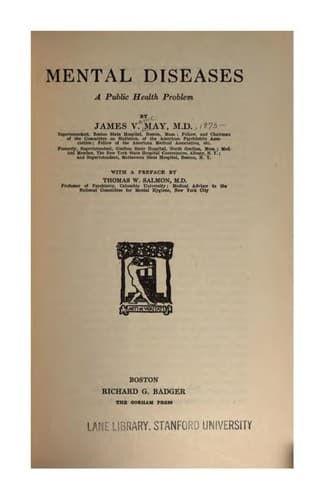
Mental diseases: a public health problemMay, James Vance
Science
Mental diseases: a public health problem
May, James Vance
Mental health services; Psychology, Pathological
Three hundred and sixteen cases from hospitals in nineteen other states
were reported as follows:—
_Number_ _Percentage_
Delirium with infectious diseases 69 21.83
Post-infectious psychoses 30 9.49
Exhaustion delirium 75 23.73
Delirium of unknown origin 33 10.44
Cardio-renal diseases 45 14.24
Diseases of the ductless glands 15 4.74
Other conditions 49 15.50
We have, thus, a total of 936 cases distributed as follows:—Delirium
with infectious diseases, 19.76 per cent; post-infectious psychoses,
16.77; exhaustion delirium, 20.83; delirium of unknown origin, 8.01;
cardio-renal diseases, 13.88; diseases of the ductless glands, 3.84;
and other conditions, 16.88 per cent. Four and one hundredth per cent
of the first admissions in Massachusetts, 3.45 per cent of the New
York admissions, and 2.07 per cent of admissions to twenty-one other
institutions during the same period of time were cases of psychoses due
to other somatic diseases. They constituted 2.81 per cent of 34,935
admissions to all of the institutions above noted.
CHAPTER XI
THE MANIC-DEPRESSIVE PSYCHOSES
The manic-depressive psychoses as first described by Kraepelin are
of comparatively recent origin. The history of the clinical entities
included in this new grouping, however, may be easily traced back to
the earliest days of psychiatry. Although these terms were not used
perhaps as they came to be later, mania and melancholia were, as has
already been shown, known in the Hippocratic era, over four hundred
years before the time of Christ. They were referred to again in the
works of Aretaeus in the first century A. D. and were recognized by
Celsus, Caelius Aurelianus and Galen. Daniel Sennert[267] of Wittenberg
(1572-1637) defined melancholia as a "delirium or deprival of
imagination and reason, without fever, with fear and sadness, arising
from dark and melancholy animal spirits, and occasioning corresponding
phantoms." Mania he described as a "delirium or deprival of imagination
and reason without fear, but, on the contrary, with audacity, temerity,
anger, and ferocity, without fever, arising from a fervent and fiery
disposition."
Sydenham[268] recommended bleeding, followed by purgation, as the
treatment indicated for mania:—"Thus the humours, which in mania would
invade the citadel of the brain, are gradually drawn off towards the
lower parts, a fresh bias being given to them."
Public-domain text, read in full here on John Shaqi.
Reviews
Reviews
No reviews yet
Be the first to share your thoughts on this work.
Elsewhere in the archive
Join the Discussion
Join the discussion
Sign in to leave a comment or review.
Sign InorCreate an account