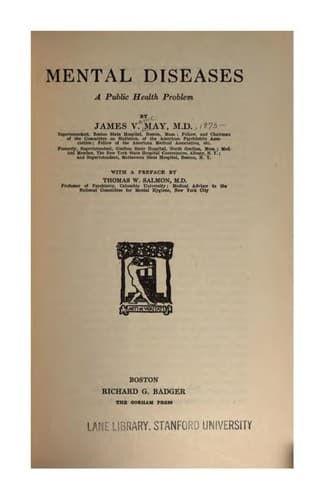
Mental diseases: a public health problemMay, James Vance
Science
Mental diseases: a public health problem
May, James Vance
Mental health services; Psychology, Pathological
Manic types:
Hypomania, Acute mania, Delusional and Delirious forms.
Depressive types:
Melancholia simplex, Melancholia gravis, Stupor, Paranoid, Phantastic
and Delirious forms.
Mixed types:
Depressive mania.
Excited depressions.
Mania with poverty of thought.
Manic stupor.
Depression with flight of ideas.
Retarded mania.
The mixed and atypical forms are of special importance, as they occupy
the middle ground between the classical types of manic-depressive
insanity and dementia praecox. It is here that difficulties arise and
errors in diagnosis are made. They have never received sufficient
attention until recently. In practice many of these have undoubtedly
been classed with the dementia praecox group. The first of these as
described by Kraepelin is depressive or anxious mania—characterized by
a depressive mood with anxiety and excitement and, at the same time, a
flight of ideas. The patients are distractible, observant of everything
in their surroundings, and complain that thoughts obtrude themselves
upon them. Some have a mania for scribbling. Often there are delusions
of persecution, sin, and hypochondriacal ideas. The mood is one of
anxiety or despair. Impulsive acts are occasionally observed. They are
inclined to weep, wring their hands, pull out their hair and throw
themselves on the ground.
Instead of a flight of ideas there may be poverty of thought and
retardation with excitement—an "excited depression." The patients
may be very wordy and monotonous in expression but are entirely clear
as to their surroundings. The mood is anxious and tearful, often with
delusions. There is a considerable excitement, but not of such a
stormy character as in the depressive or anxious mania.
Mania with poverty of thought, an "unproductive" form, shows a more
cheerful mood but without a flight of ideas. This form Kraepelin speaks
of as a common one. Speech is monotonous and expressionless. The
patients present almost an appearance of feeblemindedness, although
exceedingly variable and changeable. The mood is cheerful and sometimes
irritable. The excitement is shown by jumping around, making faces,
etc., but without any occupational activity. This alternates with
periods of quiet when but little is said. They show no desire to occupy
themselves in anything useful. Sudden outbursts of violence often occur.
Stuporous, almost cataleptic forms with occasional delusions of a
hypochondriacal type, fairly well oriented and with a clear sensorium,
are spoken of as "manic stupor." This is interrupted by excitement and
violence, with laughter, witty remarks and even eroticism. They often
have a clear memory of all occurrences. This stuporous type may appear
suddenly in an ordinary manic attack, or take place between excitements
and depressions.
Public-domain text, read in full here on John Shaqi.
Reviews
Reviews
No reviews yet
Be the first to share your thoughts on this work.
Elsewhere in the archive
Join the Discussion
Join the discussion
Sign in to leave a comment or review.
Sign InorCreate an account