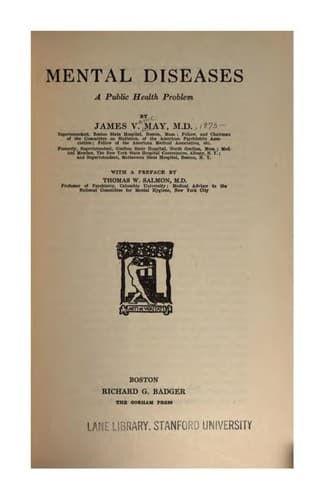
Mental diseases: a public health problemMay, James Vance
Science
Mental diseases: a public health problem
May, James Vance
Mental health services; Psychology, Pathological
had remissions of 3.3 years; twenty-four of 4.5 years; and twenty of
two years or more. Manic-depressive psychoses constitute from ten to
fifteen per cent of the admissions at Kraepelin's clinic. He found
hereditary taint in eighty per cent of his Heidelberg cases and quotes
Walker as reporting 73.4 per cent; Saiz 84.7 per cent; Weygandt, ninety
per cent; and Albrecht, 80.6 per cent. A history of alcoholism was
found in twenty-five per cent and syphilis in eight per cent of the
male patients.
Rehm made an interesting study of the offspring of manic-depressives.
Of forty-four children in nineteen families, fifty-two per cent showed
evidences of psychic degenerations, twenty-nine per cent of which
consisted in an abnormal emotional makeup usually of the depressive
types. In 157 cases from fifty-nine families, Bergamasco found that 109
showed manic-depressive psychoses. Kraepelin noted that the highest
percentage of the first attacks occurred between the ages of fifteen
and twenty. Reiss made a very significant analysis of the various
forms of the disease manifested by individuals possessing definite
predisposition. Thus, of the cases with a depressive makeup 64.2 per
cent had depressive attacks, 8.3 per cent, manic, and 27.5 per cent,
combined forms. Of those with manic temperaments, 35.6 per cent had
depressive attacks, 23.3 per cent, manic, and 41.1 per cent, combined
forms. Of the irritable individuals, 45.5 per cent had depressive
attacks, 24.4 per cent, manic, and 30.1 per cent, combined forms. Of
the cyclothymic persons, 35.3 per cent had depressions, 11.7 per cent,
excitements, and fifty-three per cent, combined forms.
An analysis of the number of cases of manic-depressive insanity
admitted to American institutions is exceedingly interesting in
view of the opinions expressed by Kraepelin. From 1912 to 1919
there were 49,640 first admissions to the thirteen New York state
hospitals. Of these, 7,499, or 15.1 per cent, were diagnosed as having
manic-depressive psychoses or allied conditions. During the years
1918 and 1919, when the Association's classification was officially
used throughout, the percentage of manic-depressive psychoses was
14.57. In the fourteen state hospitals of Massachusetts in 1919 there
were 3,011 first admissions. Two hundred and eighty-three, or 9.39
per cent, of these were manic-depressive psychoses. In twenty-one
state hospitals in fourteen other states, practically all in 1917,
1918 and 1919, there were 18,336 first admissions. Of these 3,409,
or 18.59 per cent, were cases of manic-depressive insanity. Thus, of
the 70,987 first admissions reported from forty-eight hospitals in
sixteen different states there were 11,191 cases of manic-depressive
insanity, a percentage of 15.76. This may probably be looked upon as
fairly representative of the incidence of manic-depressive psychoses in
American institutions.
Public-domain text, read in full here on John Shaqi.
Reviews
Reviews
No reviews yet
Be the first to share your thoughts on this work.
Elsewhere in the archive
Join the Discussion
Join the discussion
Sign in to leave a comment or review.
Sign InorCreate an account