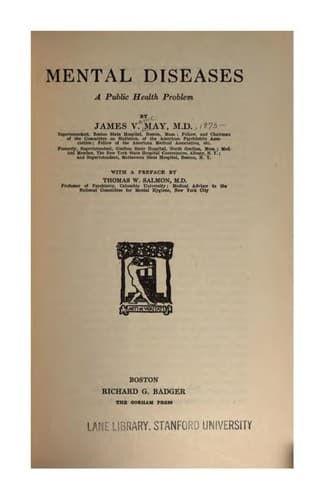
Mental diseases: a public health problemMay, James Vance
Science
Mental diseases: a public health problem
May, James Vance
Mental health services; Psychology, Pathological
isolated attack of mania in that period of life. He differentiates this
condition from agitated melancholia, leaving the question open as to
whether this constitutes a pernicious form or is a presenile disease.
According to Bumke, psychic causes are more prominent in involution
melancholia than in the manic-depressive psychoses, the duration is
longer and they do not make such complete recoveries, the most common
termination being a depressive mental enfeeblement, with despondency
and an anxious hypochondriacal mood. For the genetic interpretation of
climacteric melancholia as well as the other involutional forms the
intimate association, according to Bumke, of endogenous with exogenous
factors is the point of greatest importance. "Involution only brings
the barrel to an overflow; it only adds exogenous to the individual
endogenous momentum so that the sum total leads to the outbreak of a
manifest psychosis." Seelert goes still further with the endogenous
exogenous theory of Bumke. "It depends on the type of the association
whether the organic anxiety psychosis, a melancholia or the depression
of a manic-depressive insanity develops in the later period of life.
In one the endogenous factors predominate, in the other the exogenous
and in melancholia (in its narrower sense) the two maintain a balance."
Although, as has been noted, no characteristic pathological changes
have been associated with involutional melancholia, a condition to
which attention was called by Adolf Meyer should be referred to here.
In 1901, in an article in "Brain" on "The Parenchymatous Systemic
Degenerations mainly in the Central Nervous System" he proposed the
name "Central Neuritis" for a terminal affection previously described
by Turner in 1899 and occurring more frequently perhaps in involutional
melancholia than in any other psychosis:—"This alteration has
been found to occur in peculiar forms of end stages of depressive
disorders, near or after the climacteric period, alcoholic-senile
and alcoholico-phthisical cachectic states, idiocy, and perhaps also
general paralysis (Turner's case). Ordinary infectious and cachectic
states do not, however, appear to form an important link in the
causes."[292] The mental condition is usually anxious, agitated and
apprehensive, often terminating in a delirium followed by a stupor.
The disease may last for a few days ending in death or may recover
after several weeks. It is accompanied by progressive weakness, loss
of weight and wasting, a slight rise of temperature, and in many cases
attacks of diarrhea. Characteristic are muscular tension with rigidity,
twitching movements, incoordination and jactitation of the limbs.
The reflexes are usually increased. The onset is often quite sudden,
usually in the fourth, fifth or sixth decade of life. At autopsy a
striking condition, described as axonal alteration, is found in the
"Betz" and other large ganglion cells generally. The cell body
Public-domain text, read in full here on John Shaqi.
Reviews
Reviews
No reviews yet
Be the first to share your thoughts on this work.
Elsewhere in the archive
Join the Discussion
Join the discussion
Sign in to leave a comment or review.
Sign InorCreate an account