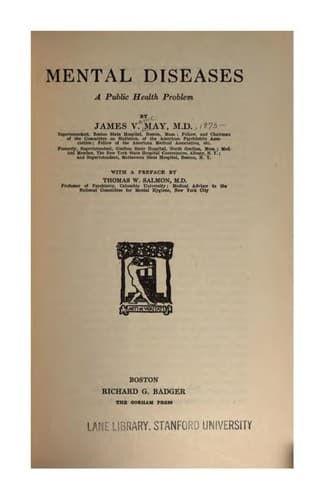
Mental diseases: a public health problemMay, James Vance
Science
Mental diseases: a public health problem
May, James Vance
Mental health services; Psychology, Pathological
The question as to what benefit is to be derived by the patient from
a residence in a hospital for mental diseases is one which is often
raised by relatives and friends. They are quite inclined to feel
that if no medicines are being prescribed nothing is being done for
the patient and that he could be cared for just as well at home.
In considering this question it should be borne in mind that the
persons under treatment in a hospital for mental diseases are there,
either because they appreciate the need of hospital care themselves,
or because, as a result of mental disorders, they are incapable of
directing their own affairs, or are, in the eyes of the law, dangerous
to themselves or others. Their property and other legal interests must
be protected during their period of incompetence. Such persons are
liable, if not adequately safeguarded, to enter into improper contracts
or make legal conveyances that mean financial ruin to themselves as
well as others. Unfortunate sexual irregularities frequently occur.
Conduct disorders of various kinds are to be expected and a tendency
towards criminal acts is common to several of the psychoses. It
is a well-known fact that every mentally unbalanced individual is
potentially dangerous, no matter how harmless he may appear. The
suicide rate of the country as shown in one hundred of the largest
cities has not fallen below fourteen per hundred thousand of the sane
population at any time during the last twenty years. The homicide rate
in thirty-one of our large cities has not dropped below eight per
hundred thousand of the population since 1909. Many of these crimes
were undoubtedly committed by persons who should not have been at
large and who were not responsible for their acts. The most important
benefit derived by the patient in the hospital is the constant personal
supervision given him by experts throughout the twenty-four hours
of the day, whether he is asleep or awake. He gets the benefit of
regular hours of rest and exercise, a properly regulated diet adapted
to his needs, a sufficient amount of fresh air, and amusement and
entertainments suited to his mental condition. He receives competent
medical, dental and nursing care and is provided with opportunities
for occupying himself in many different ways. Reading matter is always
available for those who care for it. Even religious services are held
for his benefit.
Public-domain text, read in full here on John Shaqi.
Reviews
Reviews
No reviews yet
Be the first to share your thoughts on this work.
Join the Discussion
Join the discussion
Sign in to leave a comment or review.
Sign InorCreate an account