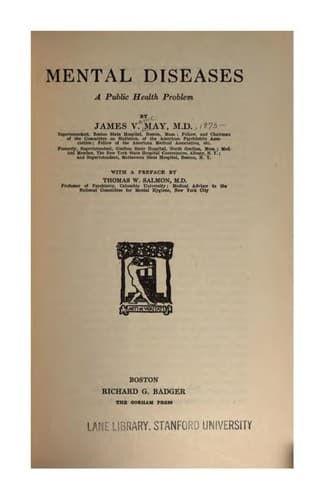
Mental diseases: a public health problemMay, James Vance
Science
Mental diseases: a public health problem
May, James Vance
Mental health services; Psychology, Pathological
The Psychopathic Hospital at the University of Michigan, the first
of its kind on this continent, was established at Ann Arbor in 1906
as a direct result of the activities of Dr. William J. Herdman. The
objects and purposes of the hospital were shown by the provision of
the legislature for the appointment of "an experienced investigator in
clinical psychiatry, who shall be placed in charge of the psychopathic
ward, whose duty it shall be to conduct the clinical and pathological
investigations therein; to direct the treatment of such patients as
are inmates of the psychopathic ward; to guide and direct the work
of clinical and pathological research in the several asylums of
the state, and to instruct the students of the State University in
diseases of the mind." It was thus an integral part of the hospital
of the University of Michigan but fully coordinated with the state
institutions. A subsequent act of the legislature changed its status
to that of a "State hospital, specially equipped and administered for
the care, observation and treatment of insanity and for persons who
are afflicted mentally but are not insane." It also provided that a
clinical pathological laboratory should be maintained for the benefit
of the state hospitals. During a period of eleven years it admitted
an average of 168.82 patients per year. Twenty-four per cent of these
were voluntary cases. The psychoses represented were: manic-depressive
insanity, twenty-four per cent; dementia praecox, seventeen per
cent; paranoid conditions, two per cent; hysteria, seven per cent;
psychopathic personality, two per cent; alcoholic psychoses, four per
cent; morphine intoxication, one per cent; imbecility, two per cent;
general paralysis, eight per cent; cerebral syphilis, one per cent;
epilepsy, two per cent; senile psychoses, one per cent; cerebral
arteriosclerosis, three per cent; unclassified conditions, five per
cent; and not insane, two per cent. Seventy-four per cent of all the
cases admitted were discharged after a residence of three months or
less and eighty-two per cent after a residence of four months or less.
Fourteen and eight-tenths per cent of all cases were discharged as
recovered and 32.7 per cent as improved. Owing to the fact that it
has only sixty-two beds at its disposal, the number of admissions is
necessarily limited and cases are carefully selected.
Public-domain text, read in full here on John Shaqi.
Reviews
Reviews
No reviews yet
Be the first to share your thoughts on this work.
Elsewhere in the archive
Join the Discussion
Join the discussion
Sign in to leave a comment or review.
Sign InorCreate an account